Interface Installation

This past month we completed the installation of Catherine Widgery’s artwork entitled Interface for the Innovation Center at Iowa State University. This site responsive art installation touches two areas of the building with two distinct designs.

Pictured: Renderings of the vestibule design and courtyard design that comprise Interface.


As one enters the building they first encounter the vestibules whose pleated dichroic glass walls break up and reconfigure our surroundings, so we see ourselves in relation to the world around us in a transformed way. Anyone passing through the vestibules is reflected multiple times in shifting fragments, a visually rich and always changing experience.

Pictured: Details of the vestibule design post installation.


The artwork located in the interior courtyard on the second level is a series of suspended ‘floating’ lacy copper screens. The thin copper panels have been cut in a chevron pattern which echos forms found in the buildings facade while referencing the pleated forms of the vestibule artwork. This canopy of suspended panels can be seen from windows above and below and within the courtyard itself.

Pictured: Detail of the copper panels.


Each panel is embedded with thousands of LED lights linked via computer software to an anemometer mounted to the building’s roof. The anemometer measures wind speed and direction so the lights dim and brighten sequentially in real time in response to the shifting winds.

Pictured: The suspended courtyard panels illuminated in the evening.


The art embodies the interface of technology at the threshold between the natural and the human built world, reflecting SIC’s wish for innovative technology to be part a of students’ exploration. What brings ‘life’ to the artwork is our capacity to monitor, record and translate information digitally. Technology translates into a visual experience the invisible energies that bring us alive to our environment through art. Interface also offers the possibility of bringing an interactive component into the lives of the students who will be able to ‘hack’ into the program and control the lighting in ways we can’t yet imagine.

For more fabrication and installation images of this project click here.

Select text from Catherine Widgery and select images courtesy of Elmendorf Geurts.

Coo Lot with Plum Pipes by Matthew Geller

Quite a few of our projects scheduled for 2020 installations were postponed so it made the ones we completed all the more cause for celebration including Matthew Geller’s latest work of public art Coo Lot with Plum Pipes.

Photo courtesy of Bob Perkoski

Photo courtesy of Bob Perkoski

Coo Lot with Plum Pipes transforms two empty residential lots by creating a new jaunty entrance to R.J. Taylor Park in Cleveland, OH which includes a spot for neighbors to saunter, meet, and gather.

Photo courtesy of Bob Perkoski

Photo courtesy of Bob Perkoski

Referencing the nearby Nottingham Water Treatment Plant, the artwork is a 135-foot labyrinthine of water pipes with a swaying bench, horizontal pipes that provide bench-like seating, and light that spills out of the vertical pipes like water to illuminate the path and trees in the evening.

Photo courtesy of Bob Perkoski

Photo courtesy of Bob Perkoski

With social distancing at the forefront of our minds Coo Lot with Plum Pipes provides ample space to sit and socialize safely and will no doubt become a welcomed addition to the neighborhood.

Photo courtesy of Bob Perkoski

Photo courtesy of Bob Perkoski

2020: A Year in Review

2020 was a year of reflection, change, and going with the flow of things. Many project deadlines shifted into the new year but despite all of the challenges 2020 brought to the industry we were able to bring three new works of public art to life. These projects responded to a need for community spaces, illumination, and big, bold eye-catching works.

We are looking forward to a busy 2021 ahead with over a dozen projects across the country currently in the works.


Check out our Projects In Progress for more info on what’s to come in the year ahead as we look forward to another year of strategic art integrations that enliven public and private spaces.

Wishing you a relaxing holiday season and new year ahead!

Los Caballos: West Texas in Glass and Bronze

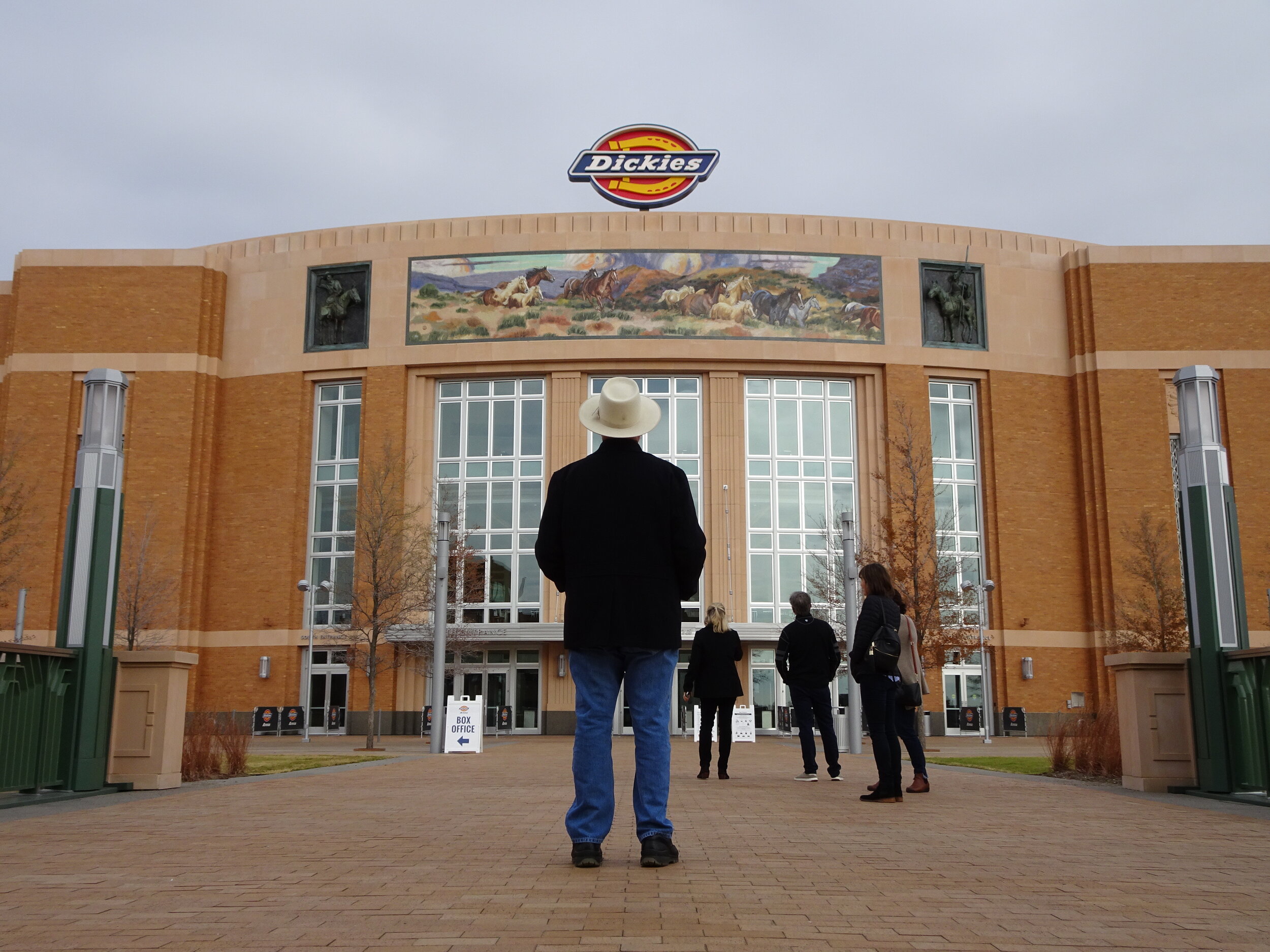
Los Caballos: West Texas in Glass and Bronze made it’s debut on Rocky Mountain PBS Thursday July 23rd. This short film features the creation of Los Caballos, a monumental work of public art created for the Dickie’s Arena in Fort Worth, Texas by Denver artist William Matthews, in collaboration with other artisans. We had the honor of managing this project for Matthews, and oversaw the process every step of the way. The final work of art is a large glass mosaic mural, 62’ long by 12’ high, flanked on either side by bronze bas-relief sculptures. The documentary follows the creation of this impressive work in Mexico and Fort Collins, as well as the installation in Texas, and celebrates the use of ancient art techniques. You can watch the full 22 minute video below.

Thank you to Amie Knox of A & K Productions and Chad Herschberger of Milkhaus Productions for following along on this journey and allowing the viewer a behind the scenes look into the creation of a work of public art.

The Story of 'The Yearling'

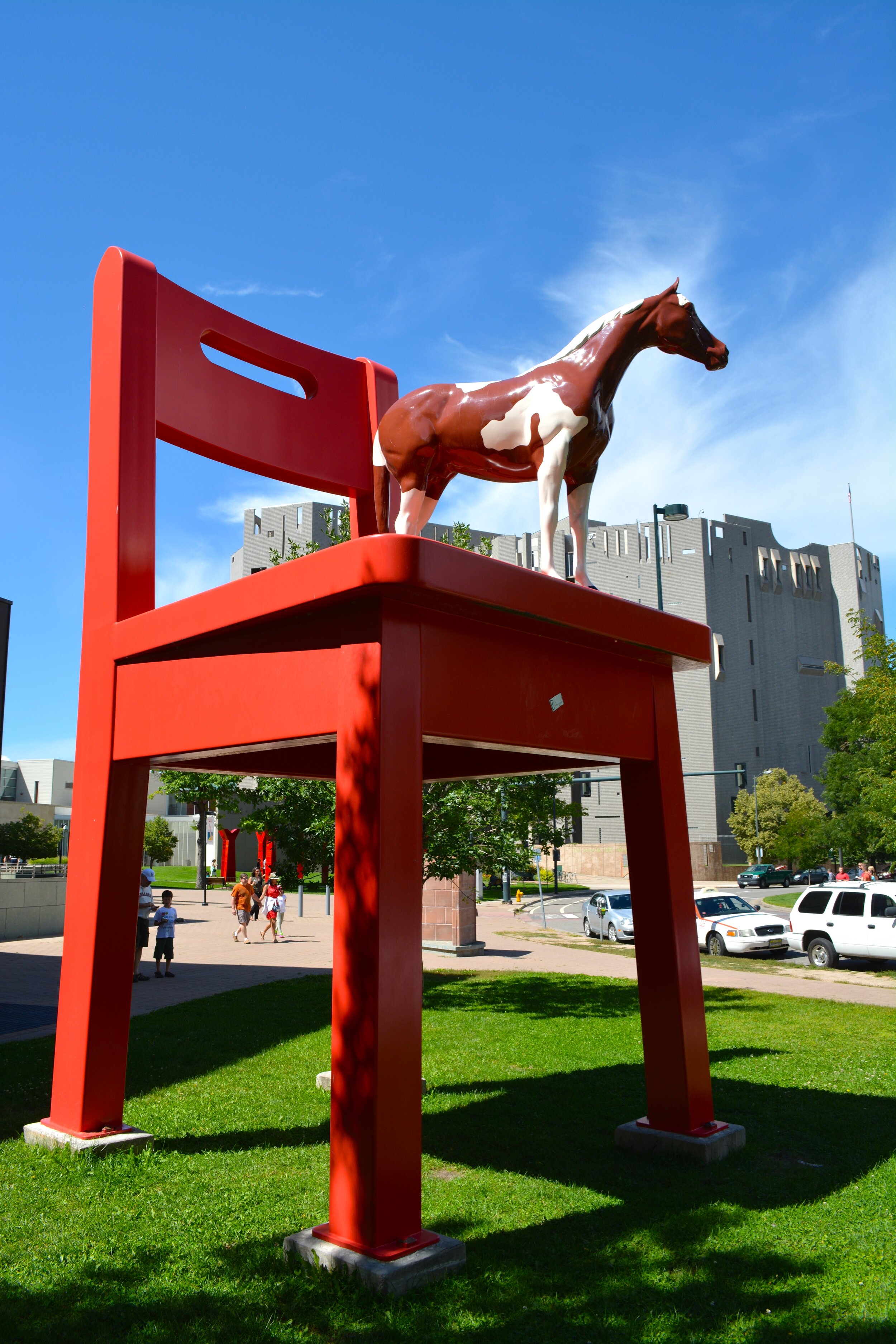
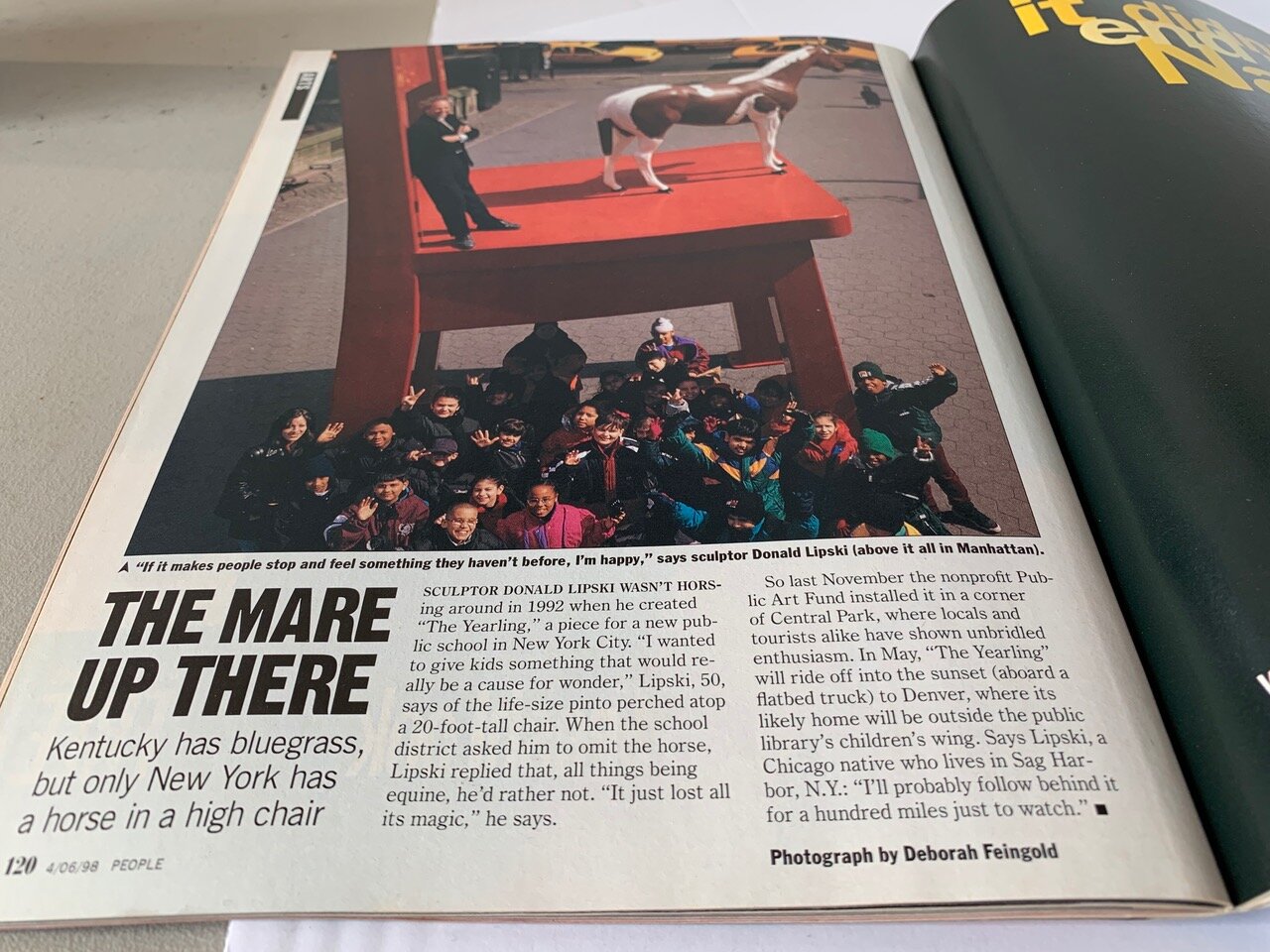
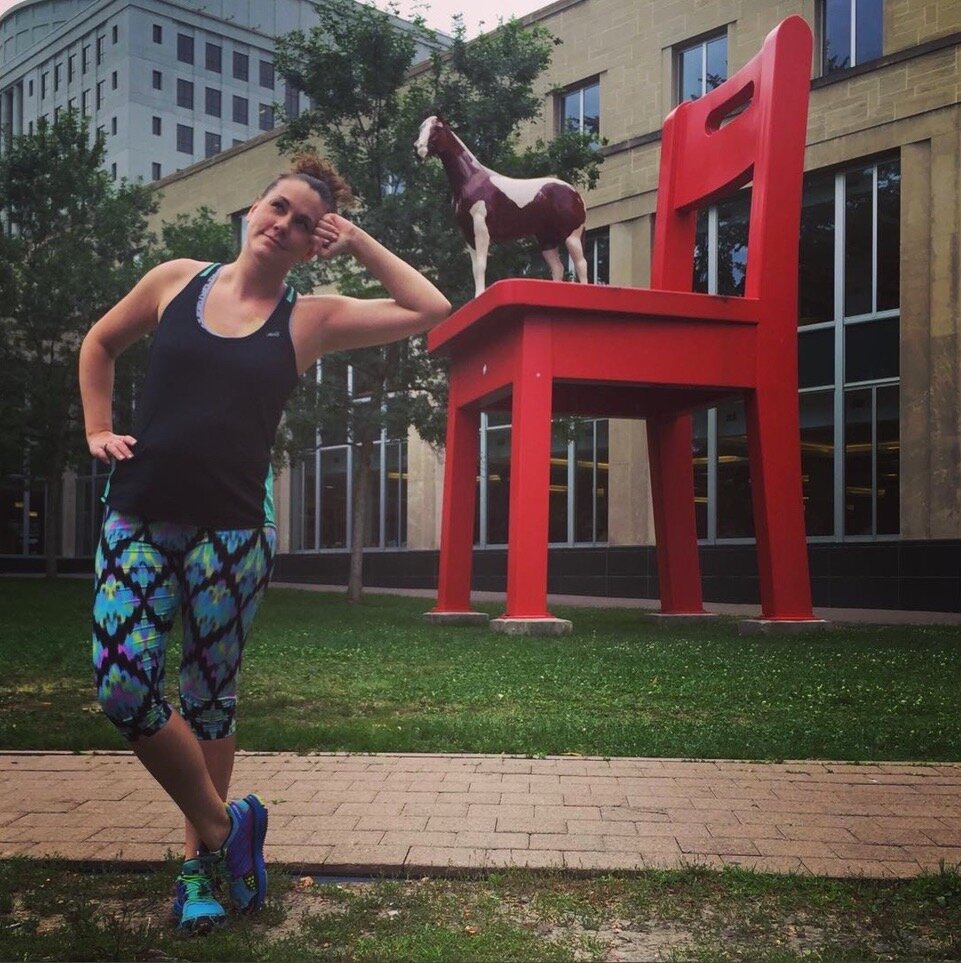
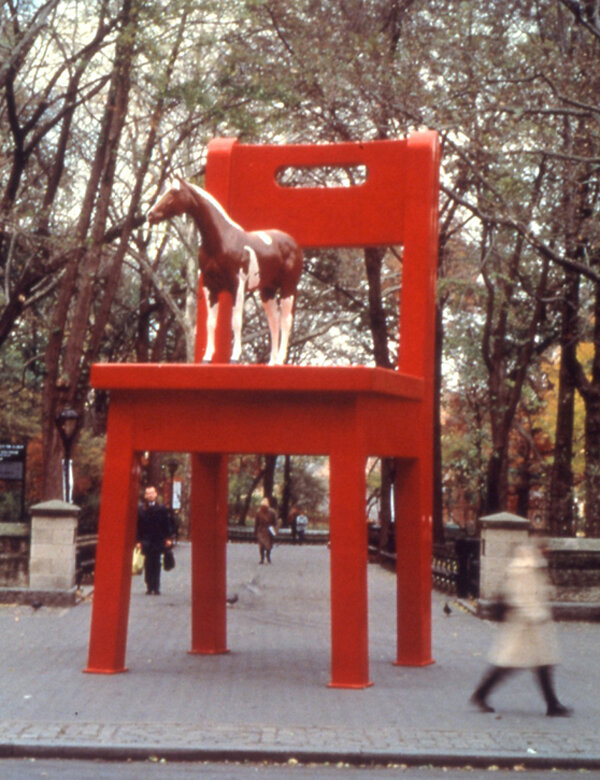
Donald Lipski’s The Yearling has become widely known in Denver and beyond since its creation in 1993 and its subsequent permanent installation at the Denver Public Library Central Branch in 1998. Today we’re going to examine it’s long journey from proposal to permanent home, over a five year timeframe. 

Donald Lipski, The Yearling, 1993

Donald Lipski, The Yearling, 1993

Around 1992 Tom Finkelpearl, who was the Director of New York’s School Construction Authority’s Art Program at the time, asked Lipski to develop a proposal for a new school in Washington Heights, located in the northern part of Manhattan. Lipski’s design for The Yearling was approved and he started the fabrication process. 

At the time the largely Dominican neighborhood had long-standing disputes with the Board of Education. Lipski explains the community’s reaction to the work, “Sometime afterwards there was sort of a dustup and the people in the community had some problems with the piece. Part of the backstory is that there was a yeshiva, a Jewish school, across the street that had opposed  the building of this school for a long time. During that process someone from the yeshiva had said ‘why spend good money to educate animals’. This obviously offensive statement stayed in people’s minds.”  

Donald Lipski’s son Jackson with an early model of The Yearling.

Donald Lipski’s son Jackson with an early model of The Yearling.

During this time Lipski also heard various other reasons why the community opposed the piece. For the Dominican community the horse could potentially be viewed as a symbol of repression because of the conquistadors use of horses during their colonization. Some raised concerns over the sculpture encouraging children to climb on furniture. In Lipski’s words, “My feeling was that  people really were taking out their anger at the Board of Education on me.” Lipski continues, “I wanted to do something that would cause the kids to imagine, to daydream. Kids are really interested in scale. They just want to be big. There's so much scale of exaggeration in children's literature. Alice in Wonderland, Gulliver’s Travels, James and the Giant Peach and so forth. At any rate the piece had been built and was in storage. There was a series of meetings. And I heard ideas like they wanted me to instead of a horse have a child wearing a mortarboard. Or a rainbow. None of these were satisfying to me. My thought was about the nobility of this horse looking out from a promontory. So I wasn't going to change the piece.”

The city continued to work to find an alternative location for the sculpture, offering it to different schools in the New York school system but they all rejected it because they wanted to remain in solidarity with this new school in Washington Heights. “So we were left with the situation where the piece had been built and paid for and was in storage, with no solution in sight,” said Lipski.  

Donald Lipski, La Guardia Suite, 1997

Donald Lipski, La Guardia Suite, 1997

Eventually an idea was developed to have Lipski create a new work for a different site and trade it for The Yearling. This resulted in the creation of  a new work for LaGuardia High School of Music and Art (located behind Lincoln Center and depicted in the movie Fame) entitled, The La Guardia Suite. This new work was installed in 1997 over the two entrances to the school’s theater and incorporated donated objects that represented the various performing arts taught at the school. “I was given violins from a violin program for children in Harlem called Opus 118, started by Roberta Guaspari, (played by Meryl Streep in the movie Music From the Heart). They had been damaged by a flood in their basement. I received ballet slippers from the New York City Ballet. I was invited to choose some costumes from the collection of The Theater Development Fund,” said Lipski. After Lipski created The La Guardia Suite, he reclaimed ownership of The Yearling

Donald Lipski, La Guardia Suite, 1997

Donald Lipski, La Guardia Suite, 1997

In 1997, The Yearling was exhibited at Doris Freedman Plaza in Central Park in New York by the Public Art Fund. As luck would have it, it caught the of eye of visitors from Denver and the The Yearling was later purchased by Nancy Tieken, who has since passed away, as a gift to the city of Denver. The piece was installed outside the Children's Wing of the Denver Public Library where it still sits today. 

Donald Lipski, The Yearling, 1997, Doris Freedman Plaza in Central Park in New York

Donald Lipski, The Yearling, 1997, Doris Freedman Plaza in Central Park in New York

So now we know how The Yearling made it to Denver, but that’s not where this story ends. The original horse that stood atop the giant red chair was made of fiberglass and due to Denver’s harsh UV rays the horse needed to be repainted every year. To alleviate this need for yearly maintenance, a mold was created of the original horse and it was recast in bronze. At the time the original fiberglass horse went on to reside in the office of Mayor John Hickenlooper who had grown fond of the horse. So fond in fact that when he was elected Governor, he took the horse with him to his new office. 

Donald Lipski, The Yearling, 1993

Donald Lipski, The Yearling, 1993

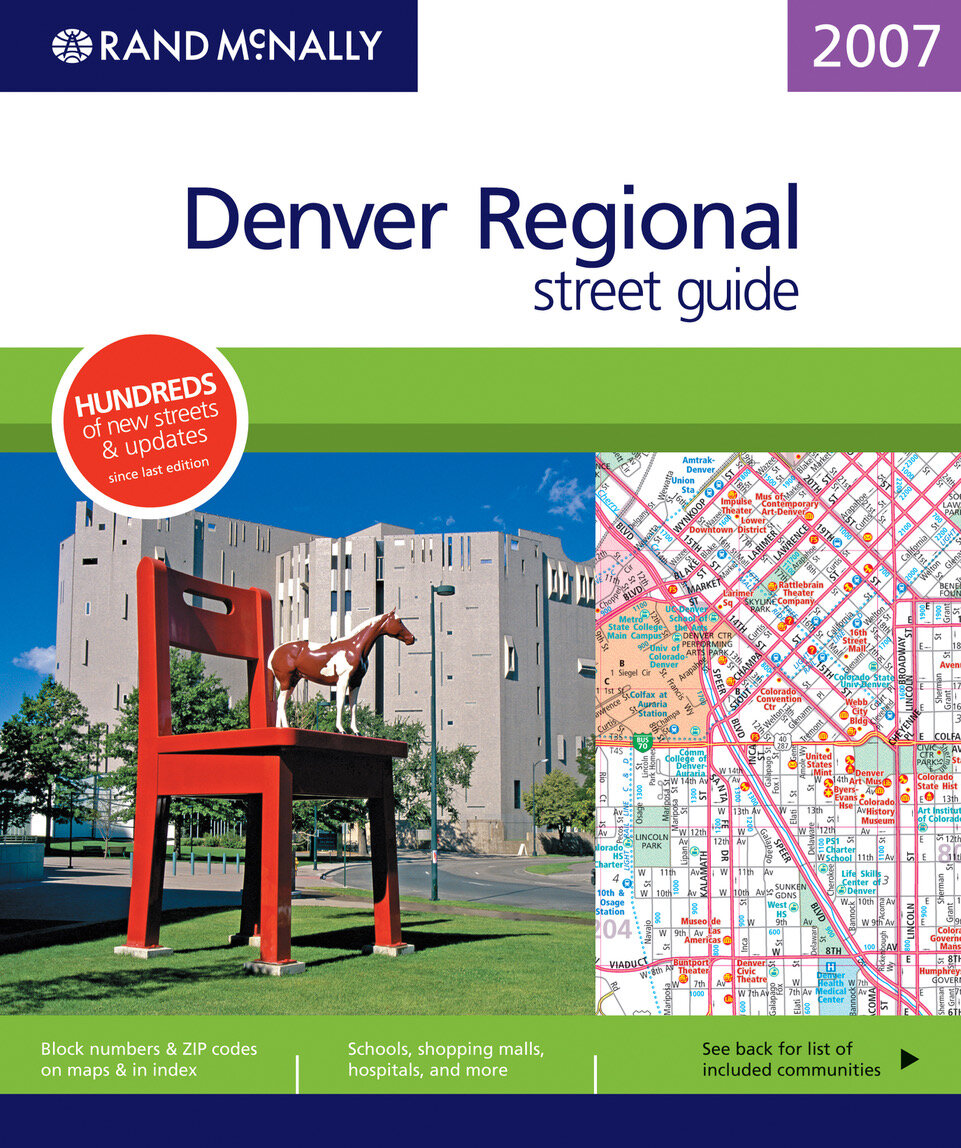
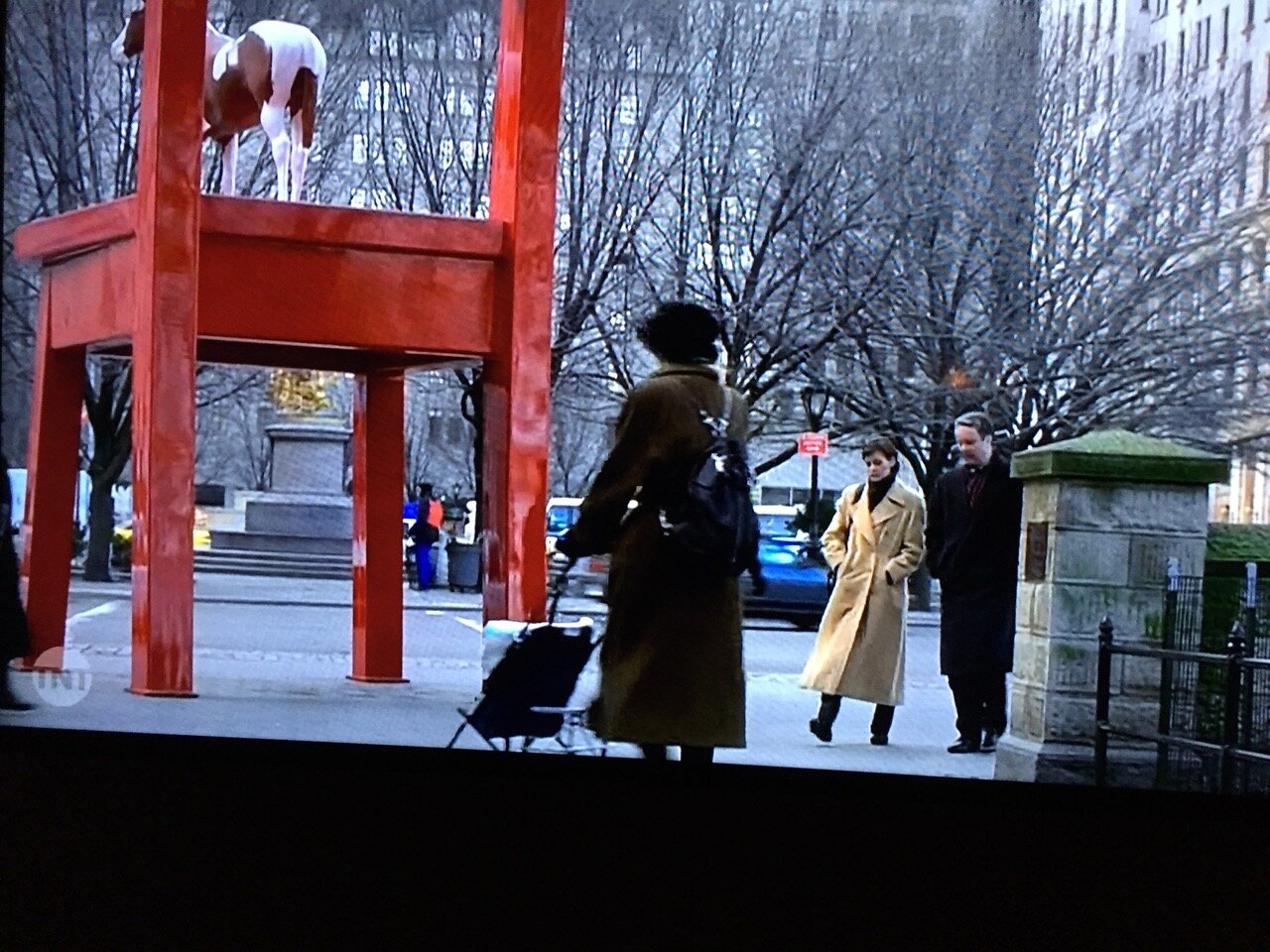
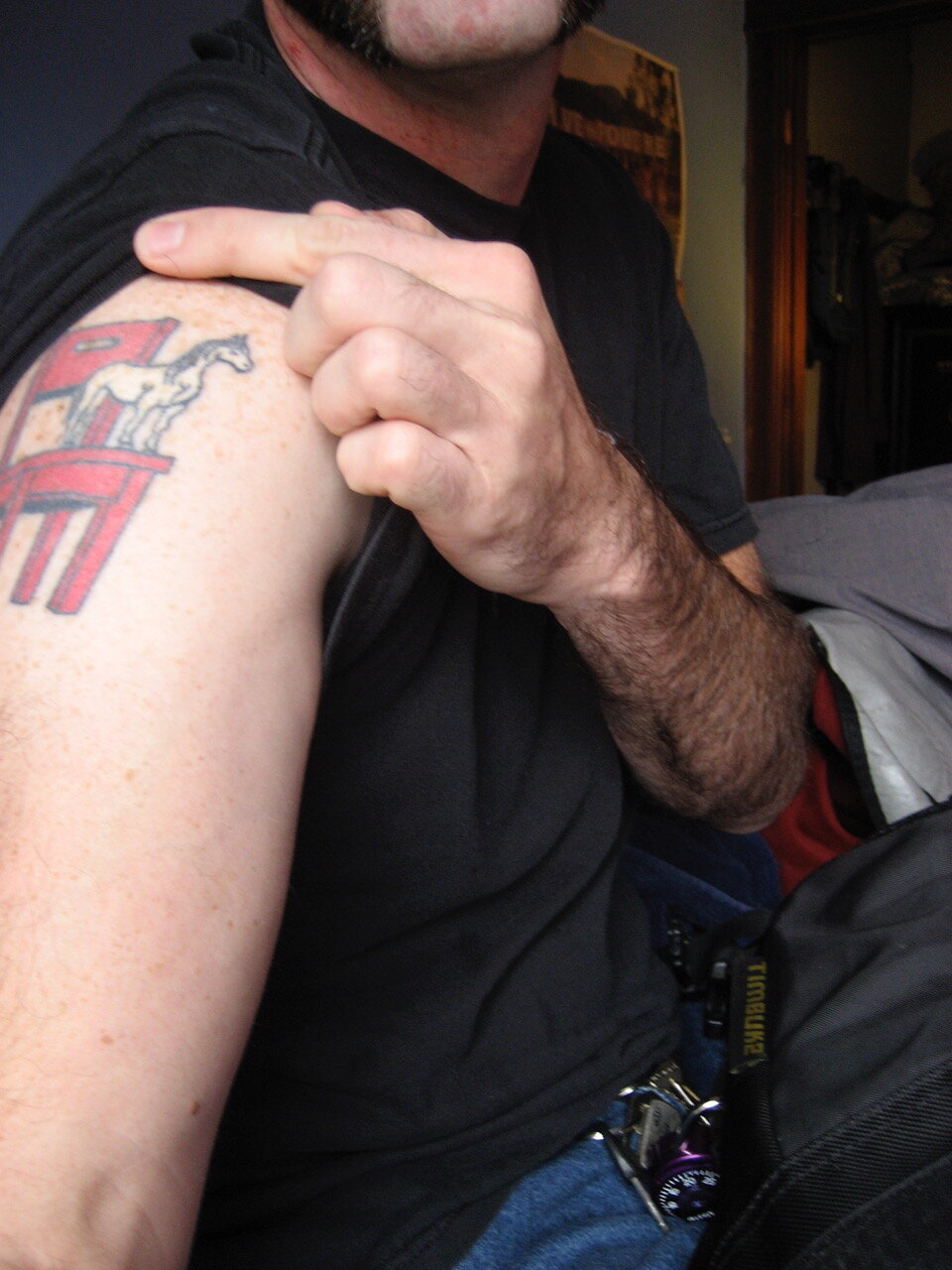
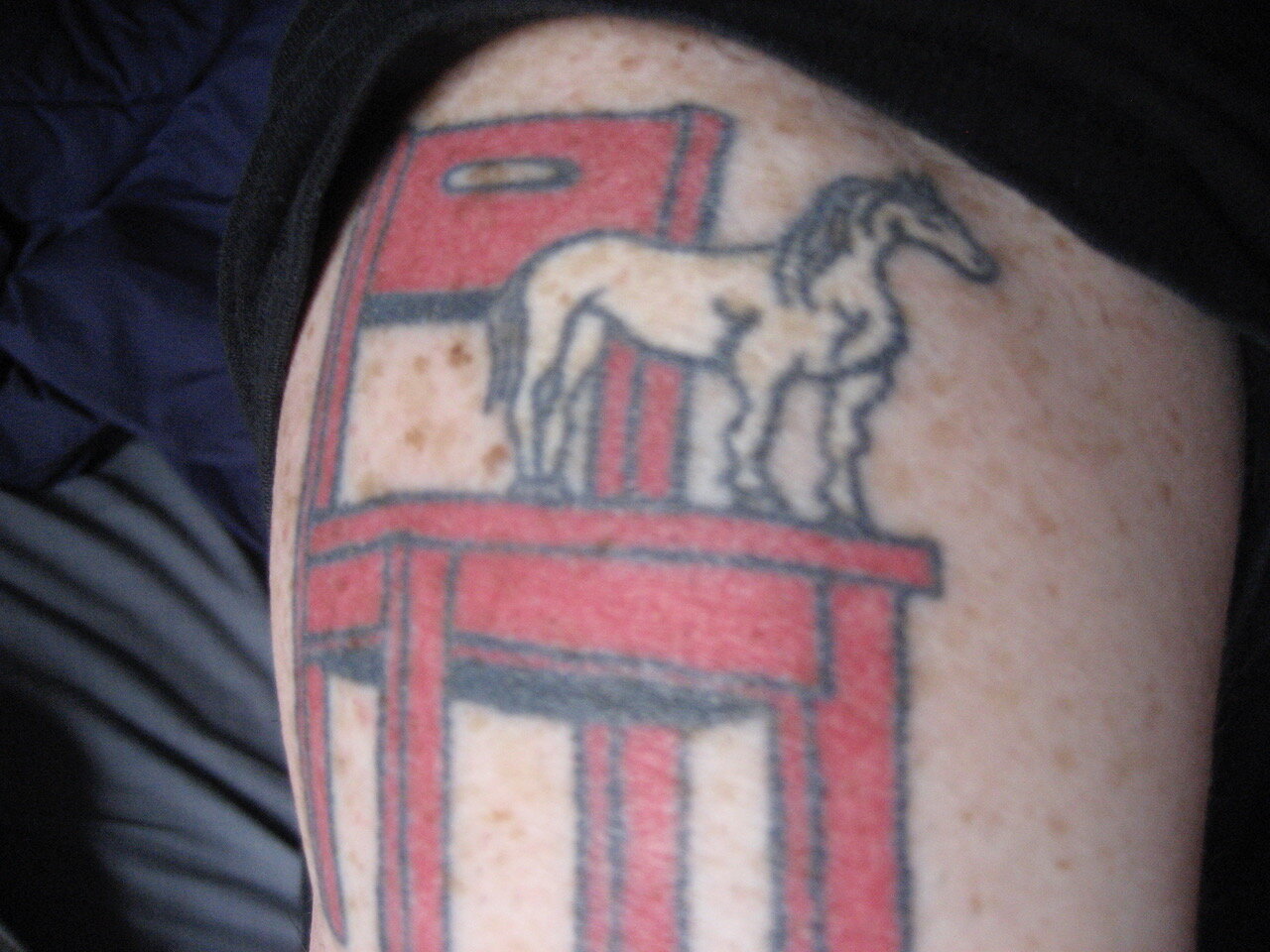
Despite its eventful origin story, The Yearling has only grown in popularity over the years. It’s been featured on the cover of the Rand McNally Road Atlas of Denver and the cover of Denver’s phone book. It even appeared on TV in an episode of Law & Order and was an answer on Jeopardy. Some individuals have even gone as far as tattooing this work of art on their bodies, using it to adorn their wedding cakes, the list goes on and on. This work also holds special significance to Public Art Services as it marks the meeting of Donald Lipski and Creative Project Manager, John Grant, who at the time was running Denver’s Public Art Program. We’ve now gone on to work with Lipski on over 25 projects with an additional 7 projects currently in the works. 

Larry Kirland's 'Pensacola Pendants'

Installation wrapped on Larry Kirkland’s design for the newly renovated Federal Courthouse in Pensacola, Florida just a couple of weeks ago. As visitors enter the courthouse they will be greeted by two identical 9’ - 6” x 4’ - 7” x 4’ - 7” hanging, sculptural, pendant lights that illuminate from within in the evening.

Exterior evening view photo courtesy of Nick Geurts.

Exterior evening view photo courtesy of Nick Geurts.

Through out the day as the sun shifts and catches the laminated, glass panels from different angles their stunning, organic blue patterns are showcased. The mirror polished, stainless steel framework reflect the blue, glass panels and the surrounding environment.

Photo courtesy of Nick Geurts.

Photo courtesy of Nick Geurts.

When viewed from below the nestled star formation is revealed. The form implies the United States of America’s official flag as well as the armed forces that are such a historical and important presence in the Pensacola region. 

Photo courtesy of Nick Geurts.

Photo courtesy of Nick Geurts.

For more information on this project and more installation and fabrication photos visit Pensacola Pendants. A big thank you to Nick Geurts for installation services and photographic documentation.

Resources for Artists Affected by COVID-19

We know these are challenging times but we’re inspired by the art communities’ response to this crisis. Artists and arts organizations around the world are struggling right now with the cancellation of events and loss of income so we wanted to compile a list of some great resources pooled from these incredible organizations RedLine Denver, American for the Arts, Creative Capital, & CBCA. If we overlooked any resources please feel free to add them in the comments section below and we’ll update the post.

IMPACT SURVEYS:

RedLine Denver has put together a short survey for Colorado artists to fill out to help them to best understand and respond to artists needs during the COVID-19 crisis.

Americans for the Arts are gathering data and impact stories through this survey link. The survey will capture a broad spectrum of data and stories that will demonstrate how the arts and culture workers triumphed and survived this crisis as well as the effect of the outbreak on operations through cancelled events, lost wages, and additional expenses. 

GRANTS, FUNDING, & FINANCIAL AID:

Denver Arts & Venues has created the IMAGINE 2020 Artist Assistance Fund to support individual artists who are experiencing immediate, unforeseen emergency needs due to COVID-19. Through the IMAGINE 2020 Artist Assistance Fund, Denver Arts & Venues has allocated $130,000 towards grants of up to $1,000 to individual artists who live in Denver whose incomes are being adversely affected due to cancellation of events, classes, performances, and other creative work.

CERF+ Announces Formation of COVID-19 Response Fund (artists can apply for relief here and if you are able to you can donate to their relief fund efforts).

https://www.westword.com/arts/denver-artists-find-solutions-to-paychecks-lost-to-coronavirus-cancellations-11663671 (this article is a great resource for those looking to support local artists as well as artists looking for support).

https://creative-capital.org/2020/03/13/list-of-arts-resources-during-the-covid-19-outbreak/ (an excellent resource for arts resources during the COVID-19 outbreak).

https://www.gofundme.com/f/denver-metro-area-artist-relief-fund (GoFundMe set up by Merhia Wiese is taking applications from artists from under-resourced backgrounds and collecting donations for the Metro Area Artist Relief Fund).

Freelance Artist Resources offers a list of resources specifically designed to serve freelance artists, and those interested in supporting the independent artist community, including actors, designers, producers, technicians, stage managers, musicians, and more.

ArtsReady is your cultural organization’s online source for readiness resources, and a web application that can make disaster planning easy.

Colorado Artist Relief Fund set up by Amber Blais is taking applications from Colorado artists in need and collecting donations to allow Colorado’s art community to continue to thrive in this difficult time.

Boston established an artist relief fund.

Ijeoma Oluo has started a GoFundMe campaign to support artists in Seattle affected by COVID-19.

The New York Foundation for the Arts (NYFA) and The Robert Rauschenberg Foundation announced a Medical Emergency grant program for artists.

The Columbus Foundation has launched a relief fund. Applications may be submitted that detail and document unexpected loss of revenue and/or unexpected increases in expenses directly related to the Coronavirus’s effect on 501(c)(3) nonprofit organizations in Franklin County, Ohio.

Springboard for the Arts has several resources and relief funds for artists in Minnesota.

Art News reports that New York small art galleries and NPOs could be eligible for emergency funds.

NYFA Emergency Grants List has a running list of additional emergency grant opportunities for artists, categorized by disciplines.

Photography:
W. Eugene Smith Memorial Fund

Performing Arts:
Doris Duke Foundation

Actors Fund Entertainment Assistance Program provides services and financial support to entertainment professionals facing personal or work-related problems. It is also a conduit for emergency financial assistance in times of pressing need or in response to catastrophic events.

The Blues Foundation HART Fund is available to Blues musicians and their families who are in financial need due to a broad range of health concerns.

Musicians Foundation is accepting aid applications.


Fine Arts:
Pollock-Krasner Foundation Grant
The Gottlieb Foundation Individual Support Grant
AAM's The Lillian Orlowsky and William Freed Grant
Joan Mitchell Foundation

Writers:

Authors League Fund helps professional writers in financial need because of medical or health-related problems, temporary loss of income, or other misfortune by providing no-strings-attached “loans” to pay for pressing expenses.

PEN American Writers’ Emergency Fund is a small grants program for professional—published or produced—writers in acute or unexpected financial crisis. Depending on the situation and level of need, grants are in the range of $2,000.


All Fields:
Harpo Foundation
John Simon Guggenheim Fellowships
Creative Capital Foundation
The Adolph & Esther Gottlieb Foundation
Graham Foundation
Artist Grant
Foundation for Contemporary Arts Emergency Grant

HOW YOU CAN HELP:

If you are looking for ways to support your local arts community consider reaching out to artists directly. Many artists are hosting online sales and posting works for sale on their social media accounts. If you purchased tickets to an upcoming arts event that has now been cancelled or postponed consider the economic impact on the artists and organizations and don’t ask for a refund (if possible), think of your purchase as a donation. Donate to relief efforts in your local community (there are many links outlined above where you can donate). Stay engaged in your local arts community online, many museum and galleries are offering virtual tours of their spaces. Ohio based painter Benjamin Cook started the Instagram account @socialdistancegallery to provide an online platform to showcase BFA & MFA thesis shows amid the pandemic. Most importantly practice social distancing and stay home if you are able to.

Double Dip Debut

The east bound traffic on E Iliff Ave in Aurora can now enjoy Elsa Sroka’s playful composition entitled Double Dip. We started work on this project in 2018 with the facilitation of the artist selection process for the site. Our client, Grand Peaks, wanted an exterior work of art that would enhance the look and feel of their newest development project, Spur at Iliff Station, and require little to no maintenance.

Elsa Sroka, Double Dip, ceramic tile mural

Elsa Sroka, Double Dip, ceramic tile mural

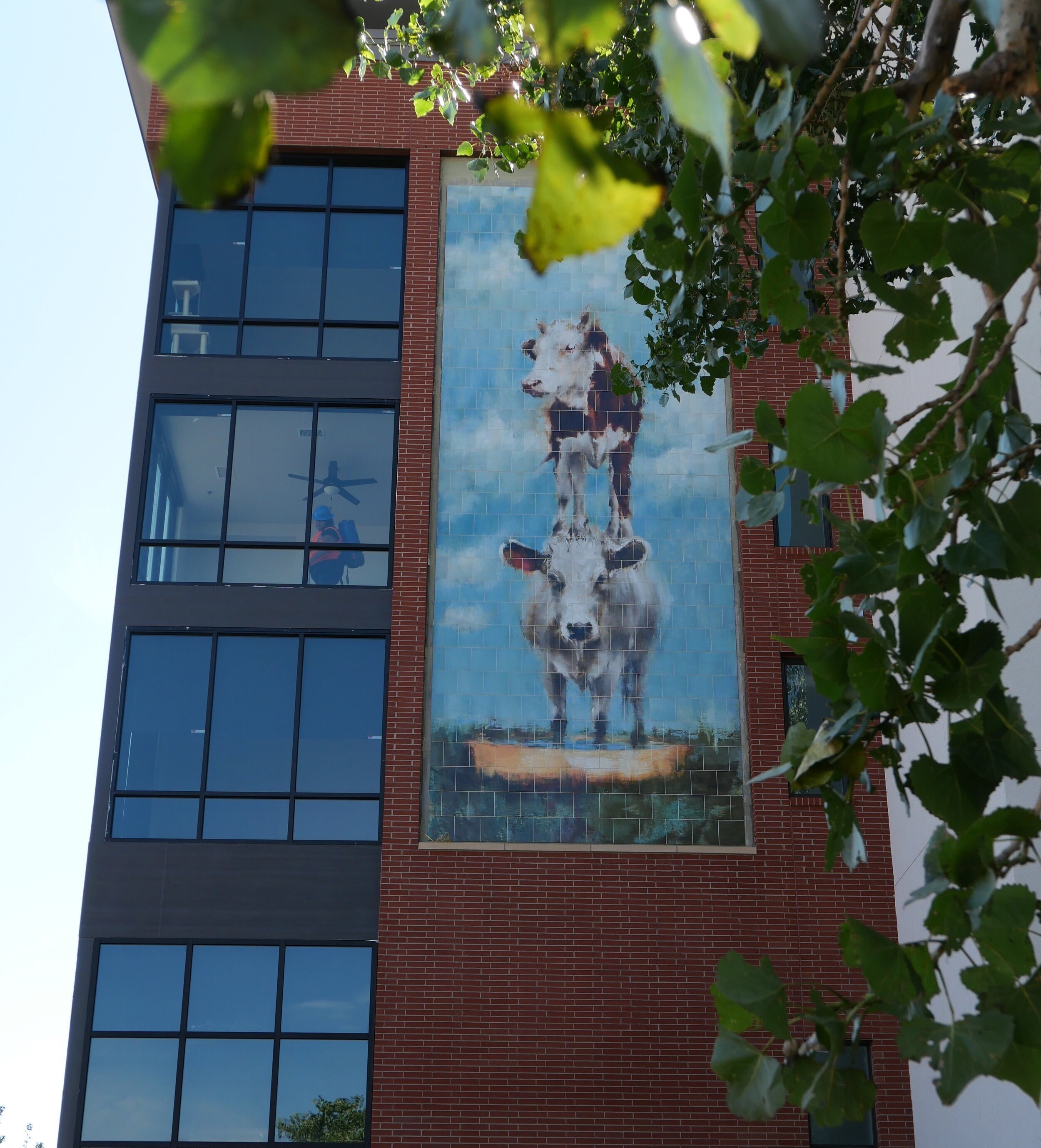
The location selected for the artwork installation is visible to passing traffic on E Iliff Ave, pedestrian traffic as well as residents of the new apartment complex, and light rail passengers arriving or departing from the neighboring Iliff Station. Material selection played a key role in the development of the project as we wanted to ensure the longevity of the artwork so rather than a traditional mural we went with a ceramic tile mural.

Unpacking of 387 - 12” x 12” ceramic tiles that make up the final 30’ x 12’ mural. Pictured left to right: Becky Wareing Steele, Project Coordinator, Elsa Sroka, Artist, and John Grant, Creative Project Manager.

Unpacking of 387 - 12” x 12” ceramic tiles that make up the final 30’ x 12’ mural. Pictured left to right: Becky Wareing Steele, Project Coordinator, Elsa Sroka, Artist, and John Grant, Creative Project Manager.

Our client fell in love with Elsa Sroka’s emotionally engaging work that adds a modern twist to the traditional western subject matter. Much of her recent work focuses on cows as the central figure placing them in unconventional settings; a conscious departure from the traditional context in which cows are depicted in much of western art. She finds the most important element to be the cow’s expression giving her subject a personality to inspire an emotional connection with both the painter and the viewer. Sroka believes the ordinary subject becomes significantly more intriguing when misplaced, inviting the viewer to pay attention through the element of surprise.

The original Double Dip painting by Elsa Sroka.

The original Double Dip painting by Elsa Sroka.

For this project Sroka painted a humorous, vertical composition of two cows, one perched atop the other, in a small wading pool. The original painting was photographed and enlarged into the final 30’ x 12’ ceramic tile mural. If you are in the Aurora area make sure you keep your eyes peeled for this precarious pair near the intersection of E Iliff Ave and S Blackhawk St.

Lipski's 'Doors' included in: "Scottsdale Is Transforming. Here Are 5 Reasons To Experience the City Now"

Yahoo Finance recently did a write up about the city of Scottsdale, AZ and included Donald Lipski’s project The Doors in their 5 reasons to experience Scottsdale now. We completed this project with Lipski back in 2007 and it’s great to see it’s still sparking peoples’ interest all these years later. Read the full article here.

The Doors by Donald Lipski is part of the Scottsdale Public Art Program. Photo by Scott McGinty for Experience Scottsdale

The Doors by Donald Lipski is part of the Scottsdale Public Art Program. Photo by Scott McGinty for Experience Scottsdale

SCALING UP: Translating paintings into large scale architectural elements

Our first installation of 2020 is currently underway at the corner of 9th Ave and Albion St in Denver, CO. We started working with our client Continuum Partners in 2018 to establish the vision for the art programming at their redevelopment project at 9th Ave and Colorado Blvd. This project reintegrates the former 26-acre University of Colorado School of Medicine campus into the surrounding neighborhood fabric by blending apartments and townhomes with retail, offices and new public green spaces. We had the pleasure of working with two Denver based painters, Kevin Sloan and Daisy Patton (who has since relocated to Massachusetts) starting in 2018 to create the two installations that were completed in 2019 for Block 7 of this project.

Site plan courtesy of Continuum Partners.

Site plan courtesy of Continuum Partners.

We’re very excited to announce that installation for our third project on this site is currently underway with yet another Denver based painter, Andrew Huffman. For Block 4 Huffman was commissioned to create two paintings that would serve as focal points on the exterior of a parking garage. Choosing his color palate carefully, Huffman created two striking, bold, patterned, geometric compositions that add vibrant focal points to the North and East entrances of the parking garage.

Modulated 32 (#1) & Modulated 32 (#2) both employ the same pentagonal tessellation pattern and color palates but differ in the placement of the colors creating a visual conversation between the two compositions as you round the corner of the building. The works are named for the 32 colors used in each composition.

In order to scale the work properly for the site Huffman created the two paintings at 1/12 the size of the final printed Structurflex panels which measure 47’ 1” x 32’ (North) and 49’ 1” x 40’ 11” (East).

Pictured: Modulated 32 (#1) (north)

Pictured: Modulated 32 (#1) (north)

Pictured: Modulated 32 (#1) (east)

Pictured: Modulated 32 (#1) (east)

You might recall our use of Structurflex in our project for Block 7 with Daisy Patton which paired a hand painted mural with Sturcturflex panels to bring Patton’s original composition to life. If you find yourself in the Denver area make sure to see these works in person and stay tuned for final installation photos coming soon.

2019: A Year in Review

2019 was a big year for Public Art Services, we wrapped up seven large scale public art installations in four cities and four of those projects just so happened to be in our home base of Denver, CO. Here’s a look back at 2019 and the artists we were fortunate enough to partner with to help bring their creative visions to life.


David Zimmer’s Echo

Photo by Public Art Services

Photo by Public Art Services

In January 2019 David Zimmer’s impressive 13 panel installation Echo made its debut on the exterior wall of the new 16 Chestnut development in Downtown Denver. We started work on this project in 2017 when we were brought on to facilitate the artist selection process and continued overseeing the project through the end of installation working closely with the artist every step of the way. Denver based artist Zimmer created an outdoor installation that is an abstraction of a majestic tree moving in the wind. The image is broken up onto 13 LED panels and reconstructed in a collage style throughout the space. The work evokes the feeling of being in nature, in contrast to its concrete and glass surroundings. The subject matter is a giant oak tree on the outskirts of Denver that Zimmer has been filming intermittently over the last 10 years. The name Echo is meant to evoke the memories that have taken place under and around the tree over the past many years. 


Jorge Marin’s Luz de Denver (Light of Denver)

Photo by East West Partners

Photo by East West Partners

The same month we wrapped on installation of David Zimmer’s Echo, Jorge Marin’s Luz de Denver (Light of Denver) was installed at The Plaza at Riverfront Park located at 1610 Little Raven St, Denver, Colorado. Luz de Denver is the most recent permanent acquisition for Commons Park and is a replica of the original Wings of the City sculpture that was included as part of a temporary installation of Marin’s work in Riverfront Park in 2016. Marin is well known for his traveling wings sculptures that originate in his studio located in Mexico and are designed for public space around the world as both temporary and permanent installations. The participatory nature of the work encourages viewers to place themselves in the composition, giving the visual illusion of wings. In Marin’s words, “We give you these wings to celebrate your victories, but also to dream and conscientiously reflect your potential as a person.”


Kevin Sloan’s The Mischief Makers 

Photo by Public Art Services (left to right: John Grant, Creative Project Manager, Chris Krieg, Muralist, Kevin Sloan, Artist, and Will Krieg, Muralist).

Photo by Public Art Services (left to right: John Grant, Creative Project Manager, Chris Krieg, Muralist, Kevin Sloan, Artist, and Will Krieg, Muralist).

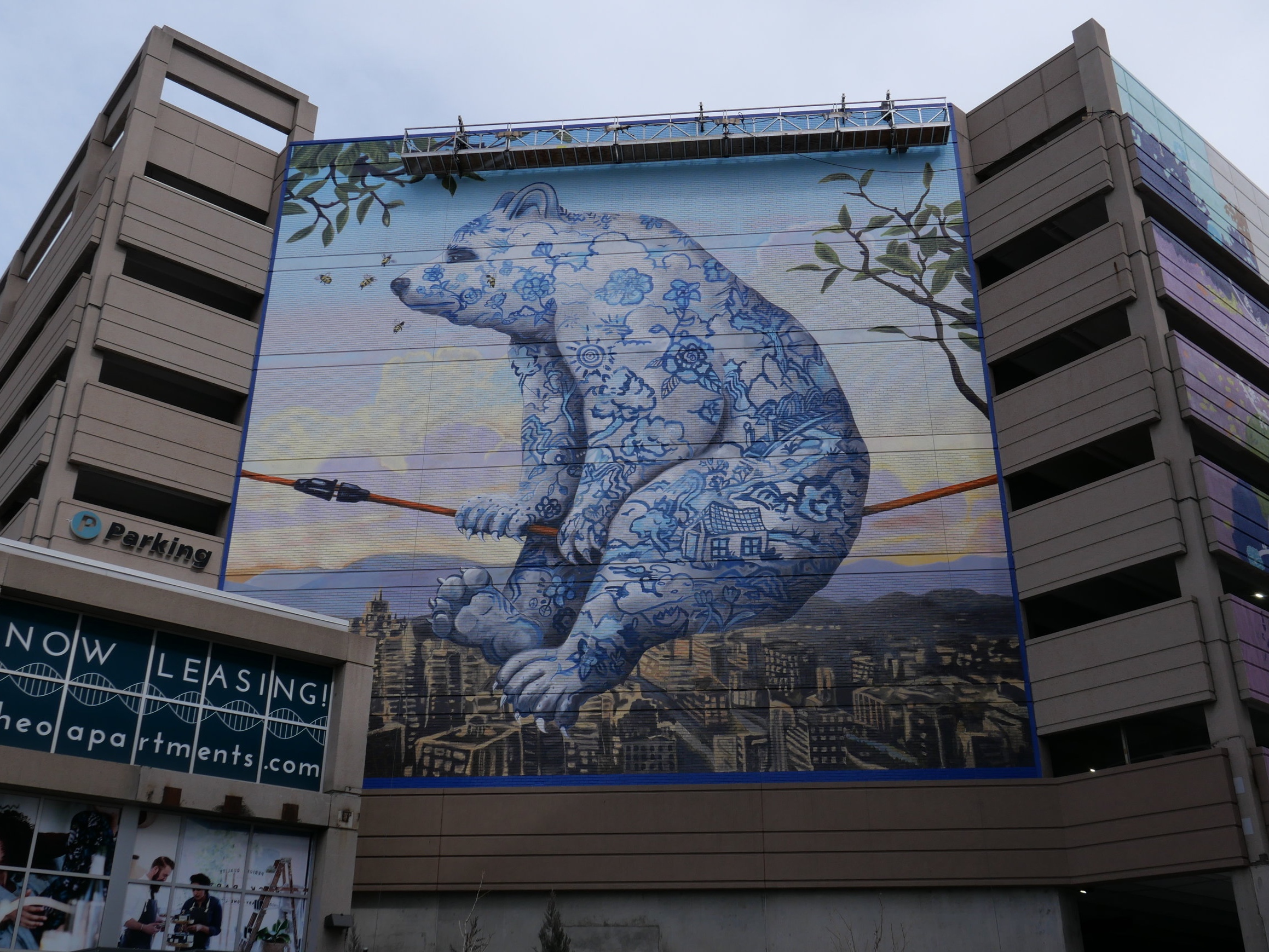
In February of 2019 Kevin Sloan’s The Mischief Makers made its debut on the facade of the parking structure adjacent to the Theo Apartments as part of the Continuum Partners redevelopment of 9th & Colorado in Denver, CO. After we conducted the artist selection process for our clients Continuum Partners, Denver based painter Kevin Sloan was commissioned to create an original work of art for the redevelopment project at  9&CO which reintegrates the former 26-acre University of Colorado School of Medicine campus into the surrounding neighborhood fabric by blending apartments and townhomes with retail, offices and new public green spaces. Sloan’s original painting was enlarged and brought to life as a 65’ x 65’ exterior mural by the father and son muralist team Chris and Will Krieg. Sloan’s work explores the relationship between the natural and human-made world. His paintings, often symbolic, deal with recurring paired themes such as fragility and strength, wonder and sorrow, and loss and resiliency.


Larry Kirkland’s Columbia River Watershed

Photo by Craig Collins

Photo by Craig Collins

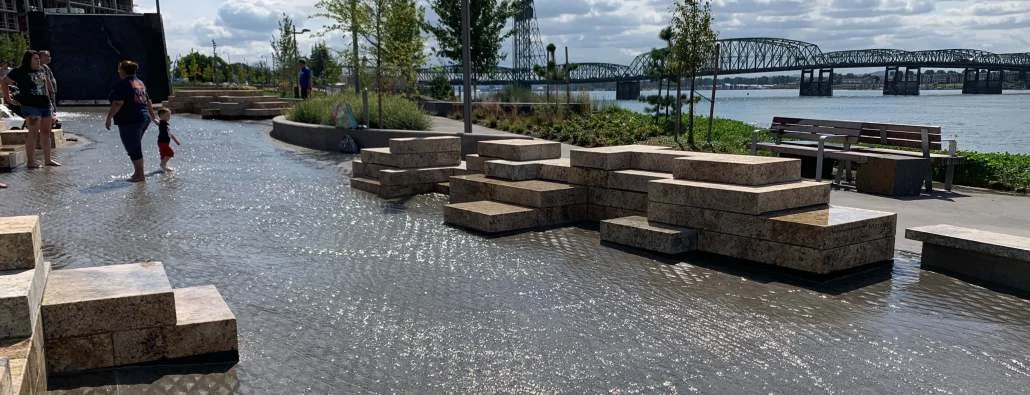
In August 2019 Larry Kirkland’s Columbia River Watershed was officially opened to the public as part of the redevelopment of Vancouver’s Water Front. The Columbia River Watershed is an interactive water feature that is both a place to play as well as learn and contemplate the Columbia River, it’s tributaries and the vast land area that makes up its watershed. The Headwaters serves as the starting point of the water feature where water flows over the etched granite surface depicting the Columbia watershed into the pool symbolizing its many tributaries. Each line was hand-cut into the granite surface between rounds of sandblasting to achieve the desired depth and dimension. On the other side of the Headwaters is a bronze casting of a topographic map which displays the source of the Columbia at Lake Columbia in British Columbia and is mounted to a Coast Green Granite slab from Brazil. Encompassing this bronze casting is an essay written by award winning author Teresa Jordan who Kirkland partnered with to try and capture the importance of the Columbia river both to its natural environment and the people who have been sustained by it.


Donald Lipski’s The Three Clans

Photo by Donald Lipski

Photo by Donald Lipski

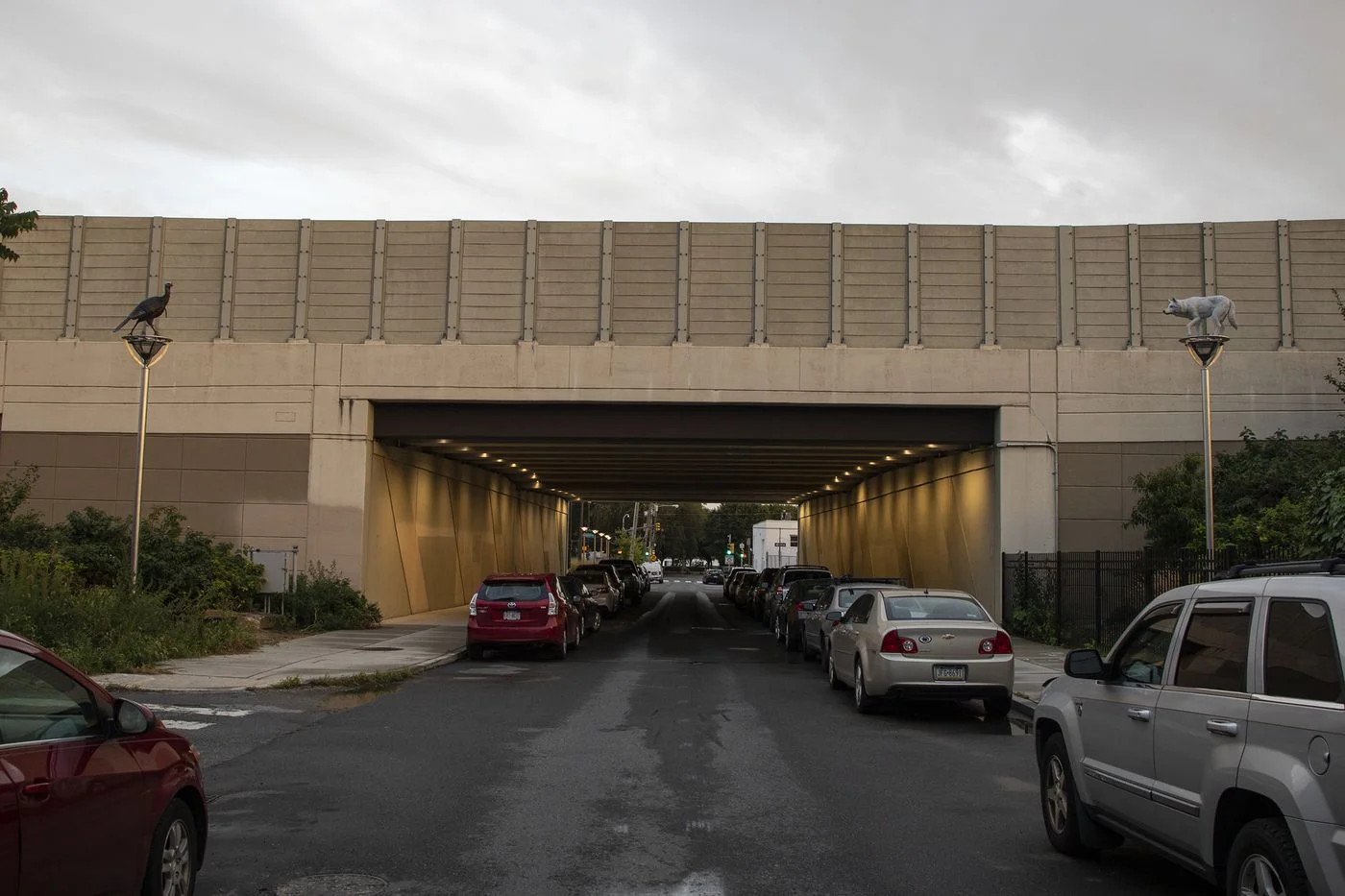
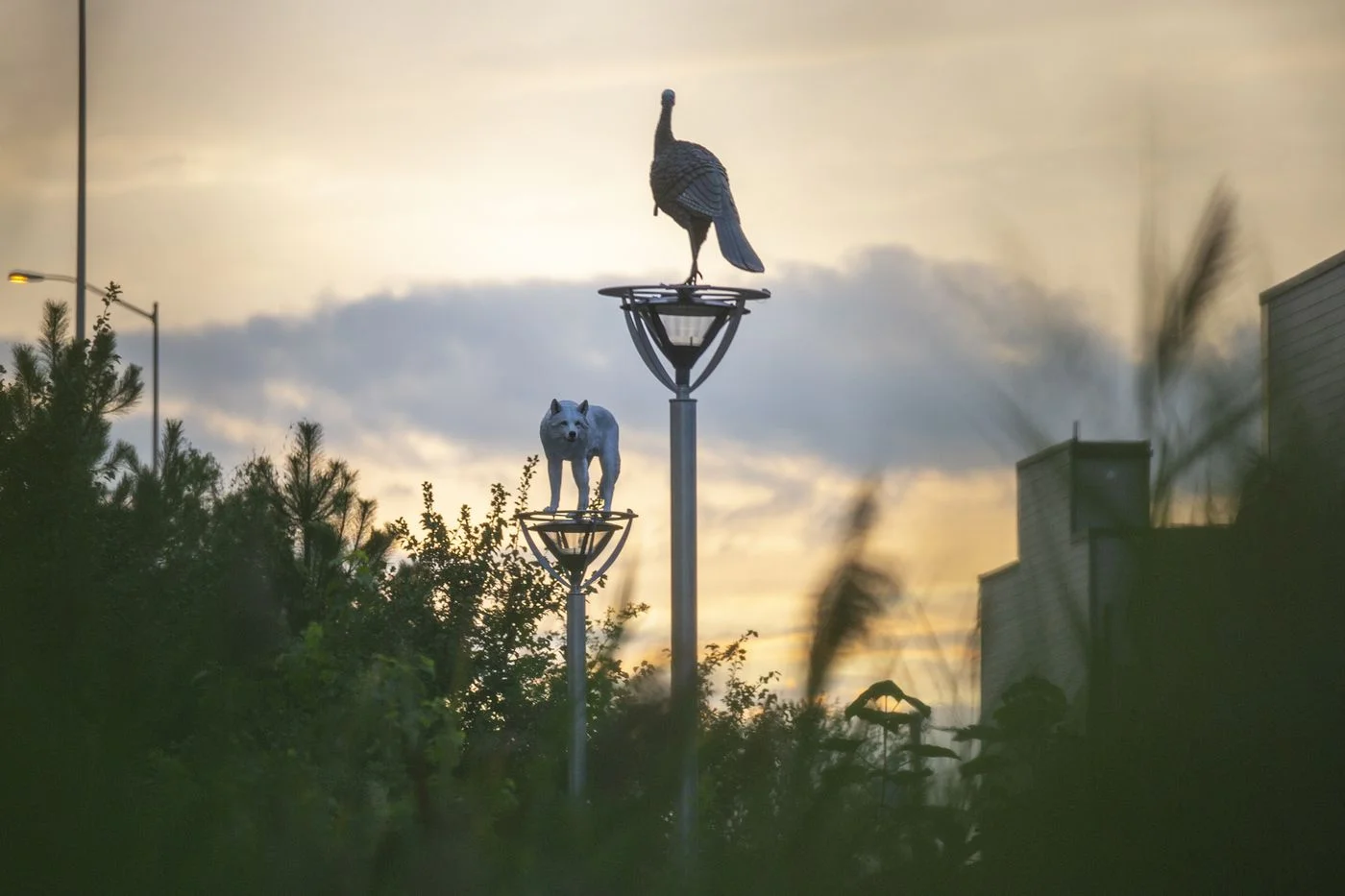
In August of 2019 we wrapped up installation on Donald Lipski’s design for the Columbia Avenue entrance to Penn Treaty Park in Philadelphia entitled The Three Clans. This work of public art pays homage to the three clans of the Lenni Lenape Tribe and Chief Tamanend, with whom William Penn signed the landmark treaty of friendship. The animals featured in this installation (wolf, turkey and turtles) are the animal symbols of the three Lenni Lenape clans. The series of five bronze turtles with light posts on their backs lead the way to the park’s entrance paying tribute to the Turtle Clan who lived in the area and Chief Tamanend who himself was a member. The fiberglass wolf and turkey are seen perched atop light posts installed on the west side of the underpass, one on the north side and one on the south. The fixtures light up at night, serving as a gateway to the park. Lipski’s design to him suggests the meeting of the Old World and the New World, but his hope is that those who interact with the work will find their own meaning as well.


Daisy Patton’s Untitled (Picnic with Flowers)

Photo by Public Art Services

Photo by Public Art Services

In August of 2019 the Structurflex panels were installed completing the installation of Daisy Patton’s largest work to date, Untitled (Picnic with Flowers). This work of public art was the second installation completed for our clients Continuum Partners in 2019 for their redevelopment of the former 26-acre University of Colorado School of Medicine campus at 9th and Colorado in Denver, CO. After conducting the artist selection process for our clients Continuum Partners artist Daisy Patton was commissioned to create an original work of art for the south facade of the parking structure adjacent to the Theo Apartments. The mural portion of Daisy Patton’s installation was completed by father and son muralist team Chris and Will Krieg in January of 2019. Patton’s paintings start from a found photograph that is then enlarged and printed out to life size. She then adds layers of patterns and color to bring the image and the people within it to life. Patton’s work explores the meaning and social conventions of families, little discussed or hidden histories, and what it is to be a person living in our contemporary world. For the project at 9th and Colorado Patton selected an image that would relate with the surrounding neighborhood and historic significance of the site. 

Stay tuned for more updates in regards to our next project for 9&CO with Denver based painter Andrew Huffman.


William Matthews’ Los Caballos

Photo by Public Art Services

Photo by Public Art Services

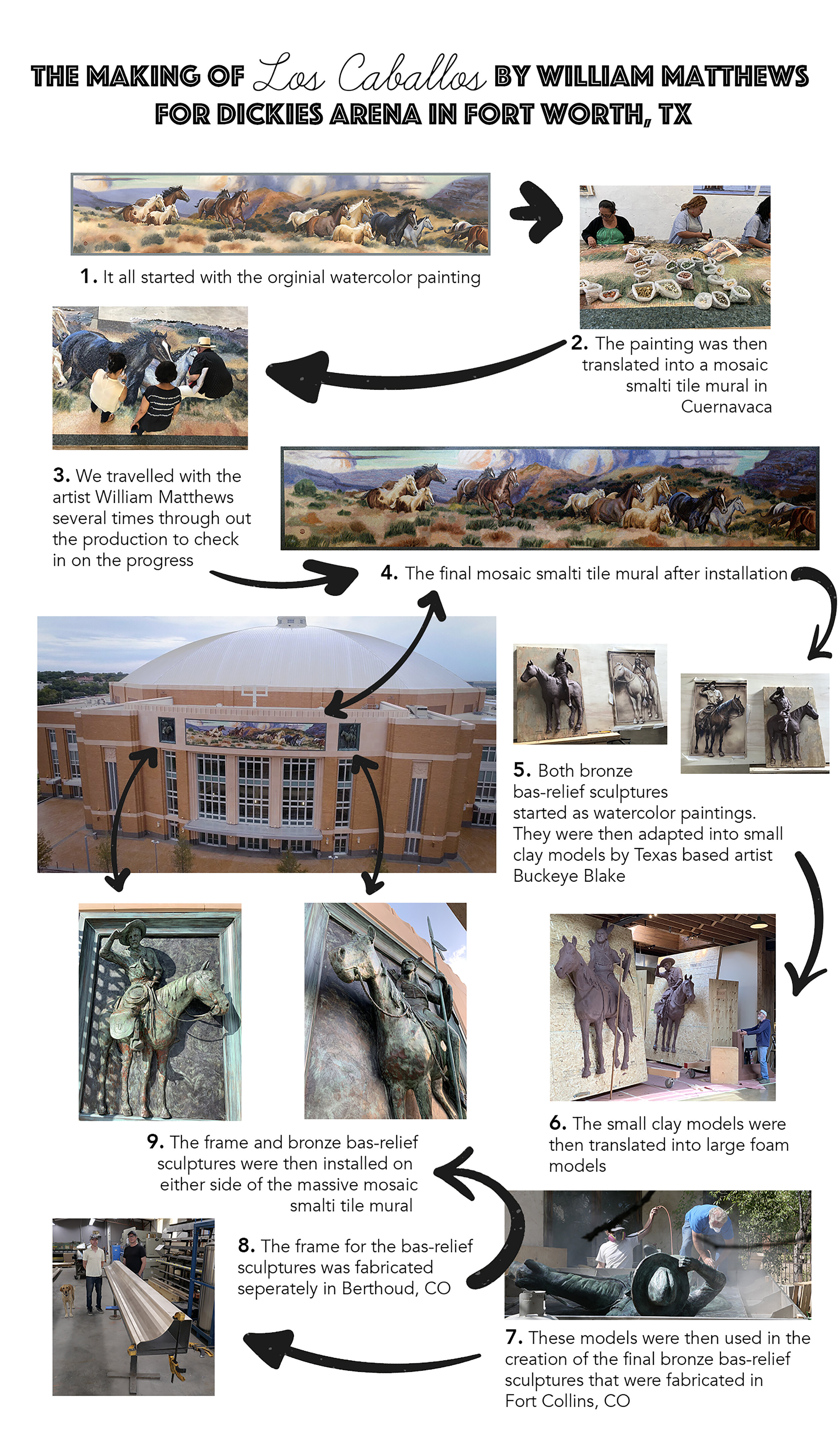
After opening 2019 with the installation of a Denver based artists work we completed 2019 with the perfect book end working with Denver based painter William Matthews’ on his design for the south entrance to the new Dickies Arena in Fort Worth, TX. Matthews’ created a stunning watercolor painting that captures the spirit and history of the West. The original watercolor painting was translated into an eye catching 63' x 12’ 2” mosaic smalti tile mural that sits above the South entrance of the new 14,000 seat, 230,000 square foot Dickies Arena, adjacent to the Will Rodgers Memorial Campus in Fort Worth, Texas. Each side of the mosaic smalti tile mural is flanked with 12’ 2” tall bronze bas-relief sculpture of a cowboy on one side and a Comanche on the other. The bronze bas-relief sculptures were adapted from Matthews’ original watercolor painting into sculptures by Texas-based artist and Cherokee Nation member Buckeye Blake and then later translated into bronze in Fort Collins, Colorado.


Elsa Sroka’s Double Dip

Photo by Public Art Services

Photo by Public Art Services

We end this post with a work of art that’s installation will be competed in early 2020. In July of 2019 Denver based artist Elsa Sroka’s ceramic tile mural was installed on an exterior wall of Grand Peaks new development project, Spur at Iliff Station Apartments in Aurora, CO. We facilitated the artist selection process for our clients Grand Peaks in early 2019 at which time Elsa Sroka’s work entitled Double Dip was selected for the commission. For several months we worked side by side with Sroka to translate her work into a ceramic tile mural that would ensure the longevity of this work of public art for years to come. In early 2020 the brick work and lighting around the artwork will be installed completing the installation. Stay tuned for project updates.

Thank you to all of our amazing partners who helped to complete these incredible projects in 2019. We look forward to another amazing year ahead full of new and exciting creative challenges. Keep an eye on the In Progress section of our website as we add new projects for 2020 and beyond.

Process in Pictures: William Matthews' Los Caballos

Earlier this month we wrapped on installation of William Matthews’ design for the South entrance to the Dickies Arena in Fort Worth, TX. It was a project that was nearly two years in the making and involved multiple fabricators and artists from Colorado, Texas and Mexico. Here’s a quick overview of the fabrication and installation process in pictures showing the transformation of the original watercolor paintings into highly durable, low-maintenance materials that will welcome visitors to the Dickies Arena for many years to come.

Here’s why there are wolf and turkey sculptures on top of Fishtown lampposts...

The Philadelphia Inquirer published an article earlier today that gives great insight into the commissioning and creation of Donald Lipski’s latest work of public art entitled, “The Three Clans” for the Columbia Avenue entrance to Penn Treaty Park in Philadelphia’s Fishtown neighborhood. We wrapped up installation on this project just a couple of weeks ago and it’s incredible to hear the warm response it’s received. Read the article below:


Here’s why there are wolf and turkey sculptures on top of Fishtown lampposts

by Anna Orso, Updated: September 3, 2019- 5:00 AM

TYGER WILLIAMS / STAFF PHOTOGRAPHER

TYGER WILLIAMS / STAFF PHOTOGRAPHER

There are some new wild animals in Fishtown. And we’re not talking about the 22-year-olds.

Take a stroll east on Columbia Avenue toward Penn Treaty Park, and as you approach the I-95 overpass, look up. Across the street from each other, two sculptures are perched atop lampposts: one of a wild turkey, the other a white wolf. On the other side of the underpass, you’ll see more. This time, a series of five-foot-long bronze, red-eyed turtles seemingly march toward the park carrying lampposts on their backs.

But alas, wolves, turkeys, and giant turtles are not native to the river wards in the same way as pigeons and, these days, Pomeranians. (Though real wild turkeys have been spotted in recent years in West Philly and the Northeast.)

So what gives?

As it turns out, the life-size sculptures — installed about two weeks ago — are part of a decade-long plan by the Delaware River Waterfront Corp. to beautify dozens of streets that serve as gateways between Philadelphia’s neighborhoods and its waterfront. The animals represent the three clans of the Leni-Lenape, who, according to tradition, forged a friendship with William Penn in 1682 under an elm tree at what is now Penn Treaty Park.

Most important among those animals are the turtles, which pay tribute to a Lenape creation story that tells of how the world was carried on the back of a turtle.

“The history of the Lenape along the waterfront is something that is hugely important, and that’s a story that should be told and is probably not told enough,” said Karen Thompson, director of planning at the DRWC. “With Columbia being the connection to Penn Treaty Park, there is a special and clear line to be drawn to connect these spaces.”

TYGER WILLIAMS / STAFF PHOTOGRAPHERFive turtle sculptures sit beneath lampposts near the I-95 overpass in Fishtown on East Columbia Ave. They are part of a decade-long plan by the Delaware River Waterfront Corporation to connect Philadelphia neighbo…

TYGER WILLIAMS / STAFF PHOTOGRAPHER

Five turtle sculptures sit beneath lampposts near the I-95 overpass in Fishtown on East Columbia Ave. They are part of a decade-long plan by the Delaware River Waterfront Corporation to connect Philadelphia neighborhoods with the waterfront.

The process that led to these animal sculptures began in 2011, when the DRWC began plotting to improve the Delaware River waterfront’s connection with city neighborhoods. Chief among those goals was beautifying what the the corporation dubbed “connector streets.” For example, DRWC unveiled a renewed Race Street in 2012, with streetscaping, lighting, and an illuminated installation along the I-95 underpass to better connect the city to the Race Street Pier.

Then, in 2016, DRWC announced the completion of the Spring Garden Street project, which now boasts colorful lighting that brightens the Market-Frankford Line underpass and escorts pedestrians from Northern Liberties to Columbus Boulevard and Festival Pier at Penn’s Landing.


Thompson said two of the next connector streets to see improvements will be Washington Avenue and Frankford Avenue. Both are in the design phase, and DRWC will next work to secure funding for construction.

TYGER WILLIAMS / STAFF PHOTOGRAPHERA turkey and a wolf sculpture stand across from each other atop lampposts near the I-95 overpass in Fishtown on East Columbia Ave.

TYGER WILLIAMS / STAFF PHOTOGRAPHER

A turkey and a wolf sculpture stand across from each other atop lampposts near the I-95 overpass in Fishtown on East Columbia Ave.

The Columbia Avenue connector project is largely complete, Thompson said, save for a plaque that explains the significance of the sculptures. She said the public art cost about $300,000 and was funded through grants from the William Penn Foundation and the National Endowment for the Arts.

Landscaping by Bryan Hanes and the animal sculpture installation — which was approved by the Art Commission in 2013 — was complicated by PennDot’s work on an I-95 ramp in the area and new construction on the block. PennDot’s work wrapped up last year.

“It was thrilling,” said artist Donald Lipski on seeing his work installed after the lengthy process. “I was just as interested in it as I was when I designed it.”

Lipski is a recognized name in the public art world. He lives in New York today, but resided in Philadelphia for about six years until 2012. At the time, his studio was located, of all places, in Fishtown.

COURTESY OF DONALD LIPSKIPhiladelphia-area artist Chris Collins stands with models of two of the seven new animal sculptures in Fishtown.

COURTESY OF DONALD LIPSKI

Philadelphia-area artist Chris Collins stands with models of two of the seven new animal sculptures in Fishtown.

He felt a special connection with the neighborhood and conceptualized the sculptures, working with local artists and brothers Christopher and John Collins to model the realistic-looking animals. The fiberglass wolf and turkey were fabricated some years ago; Lipski sculpted the bronze turtles this year at a studio in Colorado.

Lipski said there’s something poetic about pairing animals that represent indigenous people with the modern-looking lampposts that light the way. At the time of the signing of the treaty, Penn was a modern man who represented the New World.

“And the Lenape were the old world,” he said. “And there was a coming together.”

TYGER WILLIAMS / STAFF PHOTOGRAPHERA wolf and a turkey stand atop lampposts on East Columbia Ave.

TYGER WILLIAMS / STAFF PHOTOGRAPHER

A wolf and a turkey stand atop lampposts on East Columbia Ave.

Columbia River Watershed Water Feature is Open!

After nearly 5 years in the making Larry Kirkland’s design for the Columbia River Watershed Water Feature officially opened to the public earlier this month. This work serves as the focal point for the newly redeveloped Vancouver Waterfront Park along with Kirkland’s design for the Grant Street Pier. Lacamas Magazine recently published an excellent overview of the project which you can read below:


COLUMBIA RIVER WATER FEATURE AT VANCOUVER WATERFRONT PARK OPENS

2C02E001-7142-46D1-B440-6319ED1A8348.jpeg

Vancouver, Washington – The highly anticipated Columbia River water feature at Vancouver Waterfront Park (695 Waterfront Way) officially opened to the public today. 

The interactive art installation was gifted to the City of Vancouver by City Council resolution on Monday, Aug. 5. The Vancouver Parks and Recreation Department will maintain the water feature as it draws locals and visitors to enjoy the city’s waterfront for years to come. 

“I believe that carefully conceived environments can create places of meaning within communities,” said Larry Kirkland, the artist who designed the Columbia River water feature. “The best of public art can challenge, delight, educate and illuminate. But above all, it can celebrate the qualities that make each place unique and can create a sense of civic ownership. This pride of place is a building block for the future of these communities.”

Design and Details
The Columbia River water feature journey begins with the monumental structure called Headwaters. This 12-foot tall and 16-foot wide stone and bronze monolith is oriented north and south to the adjacent Columbia River.  

The east face is a cast bronze relief map of the Columbia Basin. The northern Rocky Mountains, Cascades and Coastal mountain ranges and river valleys are rendered in high relief to be touched and traced by human hands. 

The west face is an engraved stone with a topographic map of the origins of the Columbia, the “Great River of the West.” Water cascades down it in a variable flow, reflecting seasonal changes in the flow of the river. The one-inch deep river flows for 150 feet along a molded riverbed past variable-height stacks of textured granite representing each of the Columbia River’s tributaries. More water flows from between these rocks into the original river. The water is chlorinated and can be waded through and played in by visitors.

FCB4664A-08BC-40F8-8597-BCE9DA9FF91F.jpeg
A61A7B74-AFA5-44D6-AB52-C4E340F320CD.jpg

Facts about each of the tributaries are engraved on the dry side of each granite grouping. Intermingled with the factual text are quotes from literature that reference water and the flow of rivers. Combined, the facts and writingsmerge into a poetic and contemplative experience. 

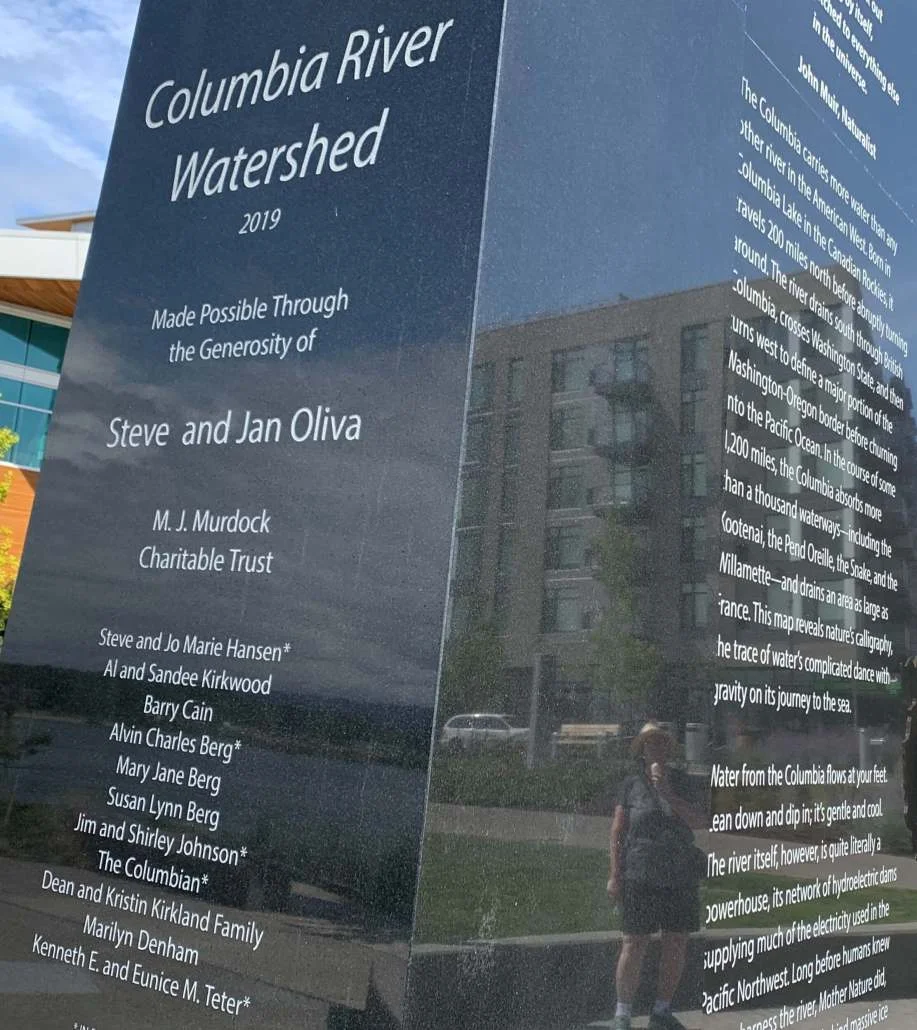
Donors to the $3.5 million project are recognized on the side of the Headwaters structure.

Donors are Steve and Jan Oliva, who also played a major role in the development of the Vancouver Waterfront, as well as the M.J. Murdock Charitable Trust. Other key donors are Steve and Jo Hansen, Al and Sandee Kirkwood, Barry Cain, Alvin Charles Berg, Mary Jane Berg, Susan Lynn Berg, Jim and Shirley Johnson, The Columbian, Dean and Kristin Kirkland Family, Marilyn Denham, and Kenneth E. and Eunice M. Teter.

“We’re really happy to have this water feature built,” said Jan Oliva. “This entire Vancouver Waterfront project has been in the works for 12 years, and there are so many good, wonderful people here in Vancouver. Larry Kirkland is the artist and John Grant (John Grant Projects) is the one who built the fountain. It’s designed to show the inlets of the Columbia flowing into it, and the ocean is represented at the end. 

“It’s going to be great for little kids. Since we’re involved in the whole waterfront development this is a key piece that is going to the city from the waterfront development group. We love what’s happening here because we feel it’s helping the whole area. There’s a great walking loop that connects us to the land bridge and the Fort Vancouver Historic Site. It’s a good thing, I’m just happy and pleased with it.”

Design and Details About the Columbia River Water Feature

  • $3.5 million gift to the City of Vancouver, accepted by City Council resolution on August 5, 2019, from Columbia Waterfront, LLC.

  • The water is chlorinated and can be waded through and played in by visitors.

  • The Columbia River water feature journey begins with the monumental structure called Headwaters.

  • This 12-foot tall and 16-foot wide stone and bronze monolith is oriented north and south to the adjacent Columbia River.

  • The east face is a cast bronze bas relief map of the Columbia Basin. The northern Rocky Mountains, Cascades and Coastal mountain ranges and river valleys are rendered in high relief.

  • The west face is an engraved stone with a topographic map of the origins of the Columbia River.

  • Water cascades down it in a variable flow, reflecting seasonal changes in the flow of the river.

  • The one-inch deep river flows for 150 feet along a molded riverbed past variable-height stacks of textured granite representing each of the Columbia River’s tributaries.

  • Facts about each of the tributaries are engraved on the dry side of each granite grouping. Intermingled with the factual text are quotes from literature that reference water and the flow of rivers.

  • Donors to the $3.5 million project are recognized on the side of the Headwaters structure.

McKeanSmith is one of the early tenants at the Vancouver Waterfront. Learn more about them here:https://lacamasmagazine.com/2019/07/mckeansmith-law-firm-expands-into-murdock-vancouver-waterfront-tower.html

The Shape of Things

Donald Lipski’s creative practice is deeply rooted in a lifetime fascination with everyday objects, often discarded by others and discovered and re-contextualized by the artist. These objects begin to work together and find their potential when paired and grouped together into assemblages. Most notably his installation entitled Gathering Dust, comprised of thousands of tiny sculptures pinned to the wall, was first exhibited at New York's Artists Space in 1978, and months later at The Museum of Modern Art as part of their Project series. Since 1993 Lipski has been increasing the scale of these assemblages in the context of public art, furthering an artistic practice developed through the exploration and experimentation with items typically viewed as utilitarian. We’ve been fortunate to work with Lipski on numerous projects over the years and it’s always inspiring to see his creative process unfold.

In a recent article for Glass Quarterly Magazine Eve Aaron perfectly captures Lipski’s excitement when discussing his artistic practice and how it relates to the viewer.

Meet "The Mischief Makers"

Thanks to Denver Life Magazine for their recent feature on Denver based artist Kevin Sloan’s first work of public art entitled, The Mischief Makers. We had the pleasure of overseeing this project on behalf our clients over at Continuum Partners as they continue to work on their redevelopment project to reintegrate the former 26-acre University of Colorado School of Medicine campus into the surrounding neighborhood fabric by blending apartments and townhomes with retail, offices and new public green spaces. This article gives great insight into the process of public art selection and gives a great overview of all the work that went into this project.

Kevin Sloan’s “The Mischief Makers”, 2018. Photo courtesy of the artist.

Kevin Sloan’s “The Mischief Makers”, 2018. Photo courtesy of the artist.

Public Art: Where to Start?

As an artist it can be overwhelming to imagine translating your studio work into public art. Here are a few tips to help get your creative gears turning.

Tip One: Determine what opportunities are right for you. CaFÉ and CODAworx are great resources for artists. These websites are updated regularly with RFQs (Request for Qualifications) and some of the opportunities are geared towards artists who have not yet completed their first work of public art. Read the call carefully, if a requirement is having completed two previous works of public art and you haven’t completed your first yet, it’s not the right fit. Connect with your local Public Arts Organization to learn more about opportunities in your area. If you are in the Denver area, Denver Arts and Venues is an excellent resource, they post opportunities and host various events through out the year geared towards educating artists about the Public Art selection process.

Pictured: Denver painter, Kevin Sloan’s original work enlarged by local mural painters for our client Continuum Partners’ new development at 9th and Colorado in Denver. This is Sloan’s first work of public art and largest work to date.

Pictured: Denver painter, Kevin Sloan’s original work enlarged by local mural painters for our client Continuum Partners’ new development at 9th and Colorado in Denver. This is Sloan’s first work of public art and largest work to date.

Tip Two: Research materials. So you’re a painter, that doesn’t mean you’re limited to only work with paint at a scale you are comfortable with. When Grand Peaks reached out to us to help them integrate public art onto an exterior wall we knew we needed to work with durable materials that could stand the test of time and stand up to Denver’s intense sun and fluctuating temperatures. Denver painter Elsa Sroka proposed a playful and imaginative composition that we had translated into ceramic tiles, increasing the longevity of the work while allowing Sroka to scale her work up for her first public art project without having to paint on a monumental scale.

Pictured: Public Art Services Team with Artist Elsa Sroka after unpacking 387 ceramic tiles that will soon be installed on the exterior wall of Grand Peaks’ new development project, Spur at Iliff Station, coming to Aurora in Summer 2019.

Pictured: Public Art Services Team with Artist Elsa Sroka after unpacking 387 ceramic tiles that will soon be installed on the exterior wall of Grand Peaks’ new development project, Spur at Iliff Station, coming to Aurora in Summer 2019.

Tip Three: You don’t have to do it all! This is extremely important for artists to remember. There are trained professionals out there to assist in the creation of your work. Dream big! We work with skilled fabricators and engineerings through out the US and abroad who can help bring your creative vision to life. All you have to do is come up with the idea and we can help with the rest.

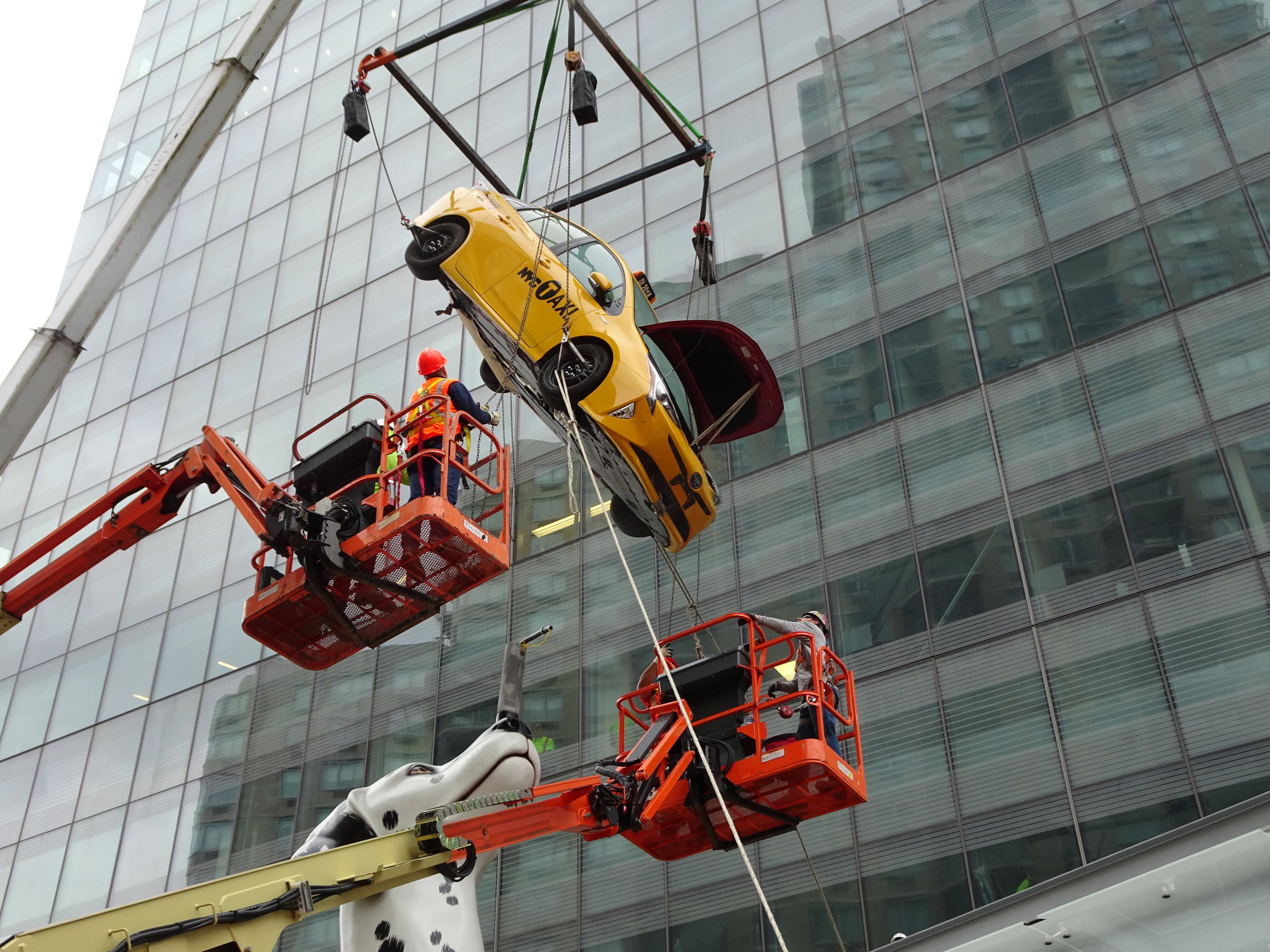
Pictured: Donald Lipski’s SPOT installed at NYU Langone's new Hassenfeld Children's Hospital in New York in Summer 2018. We led a team of talented fabricators, engineerings, lighting designers and artists to help bring Lipski’s monumental vision to …

Pictured: Donald Lipski’s SPOT installed at NYU Langone's new Hassenfeld Children's Hospital in New York in Summer 2018. We led a team of talented fabricators, engineerings, lighting designers and artists to help bring Lipski’s monumental vision to life.

What are your burning questions surrounding public art? Leave a comment below to start a discussion.

William Matthews Project Announcement

We are very excited to announce an upcoming project we’ve been working on with Denver based painter William Matthews. Best known for his depictions of the American West, Matthews is a skilled watercolor artist whose work appears in many private and public collections including the Museum of the American West in Los Angeles, the National Cowboy Hall of Fame in Oklahoma City and the Denver Art Museum, just to name a few.

Creative Project Manager, John Grant on site with the fabricators in Cuernavaca.

Creative Project Manager, John Grant on site with the fabricators in Cuernavaca.

Public Art Services, Creative Project Manager John Grant and Matthews just returned from a trip to Cuernavaca to check in on the progress of a massive mosaic tile mural reproduction of Matthews original watercolor painting.

The talented artisans behind the creation of this mosaic tile mural.

The talented artisans behind the creation of this mosaic tile mural.

Each tile is individually selected and cut by hand using special hammers. A life size reproduction of the work is used as a template to guide the skilled artisans during the creation of the mural.

A detail of the mosaic tile mural.

A detail of the mosaic tile mural.

Once completed this 63' x 12’ mosaic tile mural will be installed over the South entrance of the new 14,000 seat, 230,000 square foot Dickies Arena, adjacent to the Will Rodgers Memorial Campus in Fort Worth, Texas. When installed, bronze bas-relief sculptures, translated from Matthews original watercolors, will flank both sides of the mosaic tile mural.

William Matthews with the talented team of artisans working on his mosaic tile mural.

William Matthews with the talented team of artisans working on his mosaic tile mural.

This project is a great example of translating an artists preferred medium into a durable material that is both visually stunning and will stand the test of time as part of an outdoor installation. Check back for more updates to come on this project and visit our completed projects section to see how we worked with Matthews in 2016 to translate his work into a beautiful woven tapestry for the Country Club Towers in Denver.

William Matthews with a 12’ clay rendering for the bronze bas-relief sculpture.

William Matthews with a 12’ clay rendering for the bronze bas-relief sculpture.

If are you in the Denver area, join us Thursday March 7th from 4pm-7pm at William Matthews Studio for a sneak peek at the 12’ clay renderings for the bronze bas-relief sculptures.

Vancouver Water Feature Update

The redevelopment of the Vancouver Waterfront Park is centered around making the waterfront accessible to the surrounding community for the first time in 100 years. The Waterfront Park spans 7-acres and connects the entire 20 block development with spaces for the public to relax and enjoy the waterfront view. In September of 2018 Larry Kirkland’s design for the Grant Street Pier opened to the public and has since received some well deserved recognition. With the Grant Street Pier now complete we turn our attention to the next phase of the project, Kirkland’s design for a Water Feature with a focus on education and exploration.

Digital Rendering courtesy of Michael Mowry

Digital Rendering courtesy of Michael Mowry

Kirkland’s design for the Water Feature serves as a community gathering place that will educate and inspire. A large granite wall at one end of the Water Feature features a bronze topographic map of the Columbia River Watershed showing park visitors how water affects their environment. The water will flow through and around marble slabs stacked and engraved with significant quotes about water in celebration of this waterway and our connection to this vital element. 

Digital Rendering courtesy of Michael Mowry

Digital Rendering courtesy of Michael Mowry

Last year we traveled to Carrara, Italy to check in on the progress of the massive marble slabs being sliced and engraved as per the designs exact specifications. Since then the marble has been delivered to the work site and the installation team has begun placing them.

Photo courtesy of Larry Kirkland

Photo courtesy of Larry Kirkland

Check back for more updates on this project and make sure to follow us on Instagram and Facebook for regular project updates.

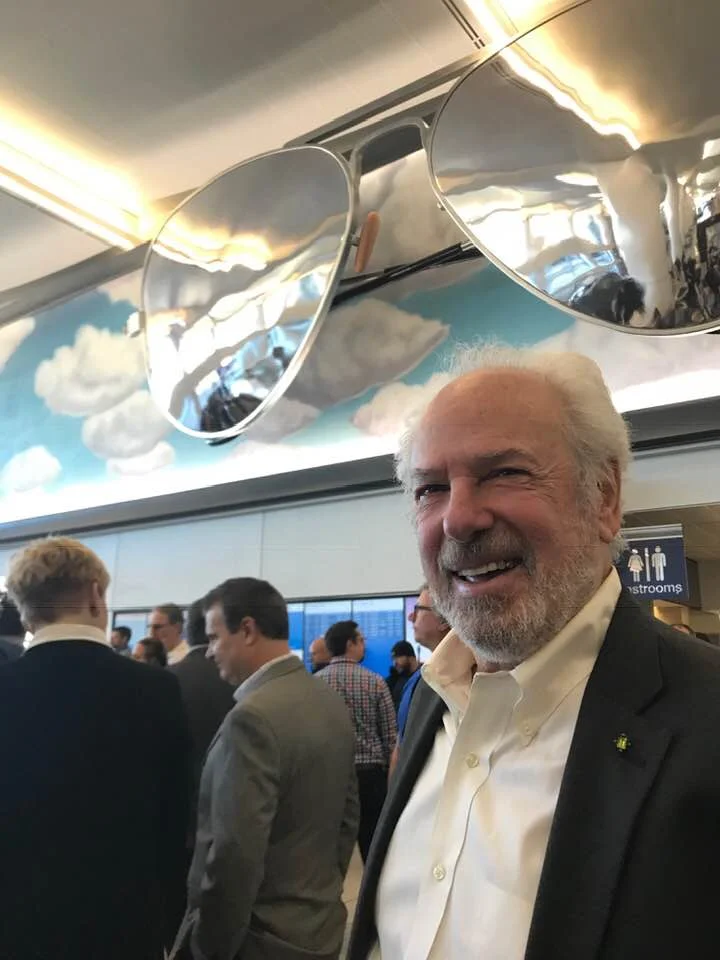
Donald Lipski's The Aviators

The Phoenix Sky Harbor International Airport recently unveiled Donald Lipski’s The Aviators as part of their newly redesigned Terminal 3. Although we wrapped up installation for this project back in November we had to keep things under wraps until the new terminal was officially open.

Photo courtesy of Donald Lipski.

Photo courtesy of Donald Lipski.

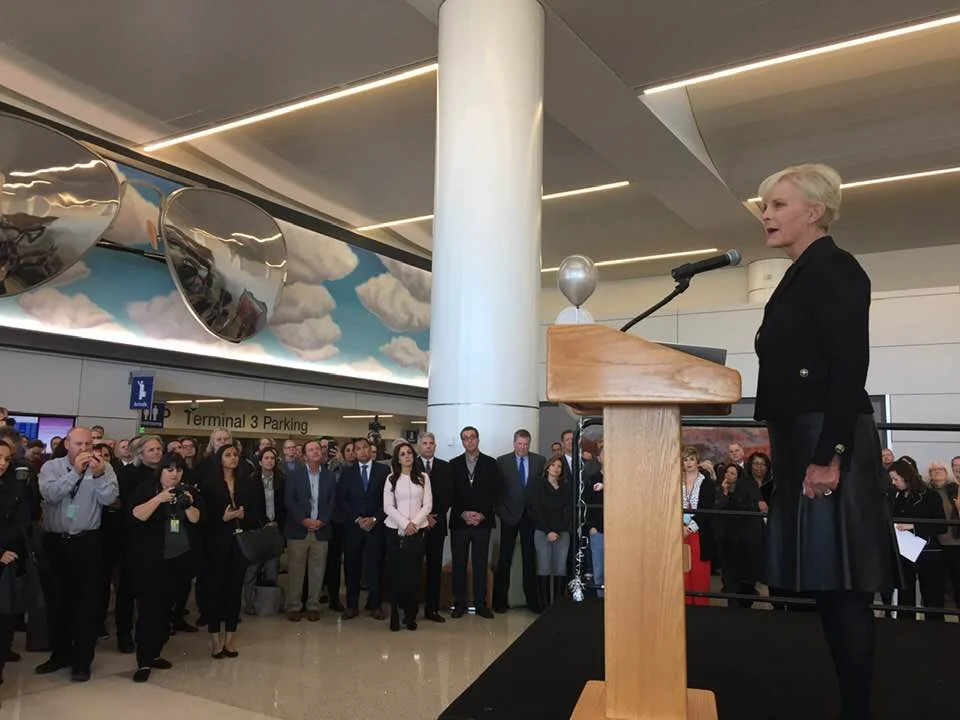
The newly-revamped terminal, which was recently re-named after John McCain, opened January 7th, 2019. Cindy McCain, wife of the late Arizona senator, was in attendance at the press conference and had this to say about Lipski’s design, "The aviators up there are the best. I can say, John would've loved that."

Photo courtesy of Donald Lipski.

Photo courtesy of Donald Lipski.

The Aviators, consists of three parts: an enormous pair of mirrored aviator sunglasses measuring 25’ x 9’ and weighing in at 2,000 lbs, which hover in front of a 90’ wide oil-on-canvas painting of a sky with clouds, which is framed in a traditional wooden frame, which houses lighting.

Photo courtesy of Donald Lipski.

Photo courtesy of Donald Lipski.

It was a pleasure as always working with Donald Lipski and our wonderful team of collaborators to bring this work to life. Congratulations Donald! Click here to learn more about this project.